Robert Anderson lived a life of service and adventure, a life that will earn him posthumous induction into the Litchfield High School Hall of Fame this year.
He was born March 25, 1922, in a farmhouse near Round Lake to Swedish parents. His father, John, a farmer, county commissioner, and Mason, emigrated from Sweden to Minnesota through Ellis Island at age 16. Robert’s mother, Ruth, was born in Litchfield to Swedish parents, and loved to play the piano, sew, and cook. Robert had a cherished older brother, Bud, and laughter and joy filled their home.
When Robert was seven years old, his father died. It was about the time the Great Depression was starting, a tumultuous decade of plunging farm incomes, severe recession and high unemployment. Ruth Anderson managed to hang on to the farm and to raise her two sons. Remarkably, the farm is still in the Anderson family today.
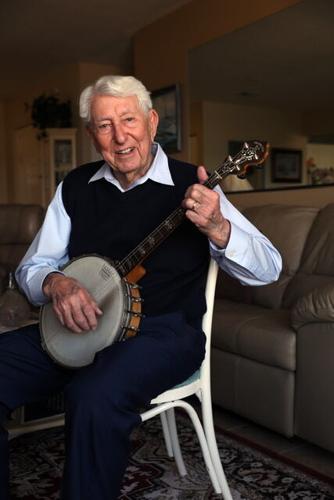
He grew up poor, but Robert felt loved and supported by his family and the Litchfield community. In his early years, he attended a one-room country schoolhouse, and later trapped muskrats and played the banjo in bars during high school to earn money. He continued to love music and play guitar and banjo throughout his life.
When he graduated from Litchfield High School in 1940, he excitedly looked in his envelope for his diploma just like all his classmates were doing, but it was empty! The following week, when he finally found the person who knew why he didn’t receive a diploma, he was told he owed $4 for the bus from ninth grade. School transportation had been free since 10th grade, and Robert hadn’t been told he owed bus money. He was never able to get his actual diploma for reasons he can no longer remember. Happily, at a Litchfield High School class reunion years later, his classmates presented him with a paper Litchfield High School 1940 diploma they had made especially for him.
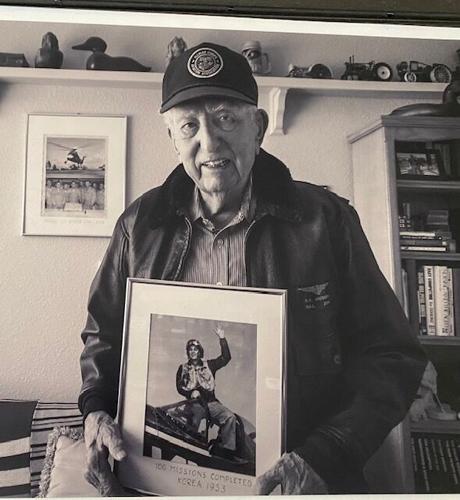
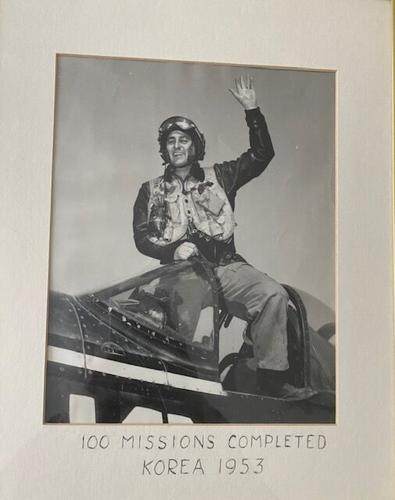
After working on the farm and driving trucks with his brother Bud, and then working for Northwestern Bell Telephone Co., Robert signed up for Navy pilot training in 1942, just six months after the start of World War II. He was called to active duty in January 1943 and began a lifelong career of flying various aircraft, from jet planes to helicopters. He flew in three wars, World War II, the Korean War and the Vietnam War, eventually retiring from military aviation and becoming a flight operations instructor with United Airlines.
Robert was a Mason for almost 75 years. One of his grandsons was proud to accept a college scholarship from a Masonic lodge in Colorado.
Robert met and married the love of his life, Phyllis Green Anderson on Aug. 18, 1945. She was born and raised on a farm in Newfolden, Minnesota, and the daughter of Norwegian parents. They were married more than 70 years before Phyllis died in 2016, and they had a life filled with love, laughter, adventure, many rounds of golf, three children, and 15 grandchildren and great-grandchildren.
He was a major in the Marines. He received numerous aviator medals and military gold stars, as well as being awarded the Distinguished Flying Cross from President Dwight D. Eisenhower in April 1953.
Robert’s various aviation awards were presented for “heroism, extraordinary and meritorious achievements ... and unswerving devotion to duty.” He was honored for “leading his division to target heavily defended and well-entrenched hostile positions. ... showing outstanding skill and courage” and was recognized in “deep appreciation of your devotion to duty and gallant action for the United States Marine Corps.”
One of Robert’s Corsair fighter planes was hit by anti-aircraft enemy fire while he was flying a mission in 1953. An enemy artillery shell exploded inside his plane, but he was able to fly and safely land the plane 60 miles away at his military base. He completed more than 100 war time flight missions.
After the war, Robert flew helicopters in support of NASA, the newly formed United States space program. The Mercury space program, was based in Cape Canaveral Air Force Station, Florida. Mercury was the first human space flight program of the United States, and John Glenn was one of the first astronauts. Robert’s flight crew was trained to fly and retrieve, by helicopter, the first manned space capsule out of the Atlantic Ocean after it returned from orbiting in space and safely splash landed.
In 1962, Robert flew a support helicopter for President John F. Kennedy during the dedication of the United States water conservation program, Whiskeytown Dam Recreational Area, in Redding, California.
He retired from military service in 1964 and briefly became a real estate agent in southern California before being hired by United Airlines in Denver, where he was a flight operations instructor for planes including the Boeing 720 and 747, as well as the Douglas DC-10. He retired from United Airlines in 1980, and he and Phyllis (a real estate agent) enjoyed playing golf, traveling, and continuing their hobby of buying, fixing up and selling homes.
Finally, Robert was patriarch of his loving family. He and Phyllis maintained their Minnesota roots, and enjoyed their summer cabin on a lake for many years in Park Rapids. Family summers were spent at the lake enjoying fishing and water sports, playing golf, or visiting and entertaining family and friends. Phyllis was a golf club champion many times over. All three of their children were born on or near different military bases where they were stationed at the time. Robb in Honolulu, Hawaii; Karyn in Quantico, Virginia; and Kristin in Corona, California.
When asked three months before his 100th birthday what wise advice he could offer for a satisfying life, Robert said one should have a loving family, a sense of humor, a spirit of service and gratitude, and to do your best in all things.
He died June 5 this year in Colorado.
His was clearly had a life well-lived.