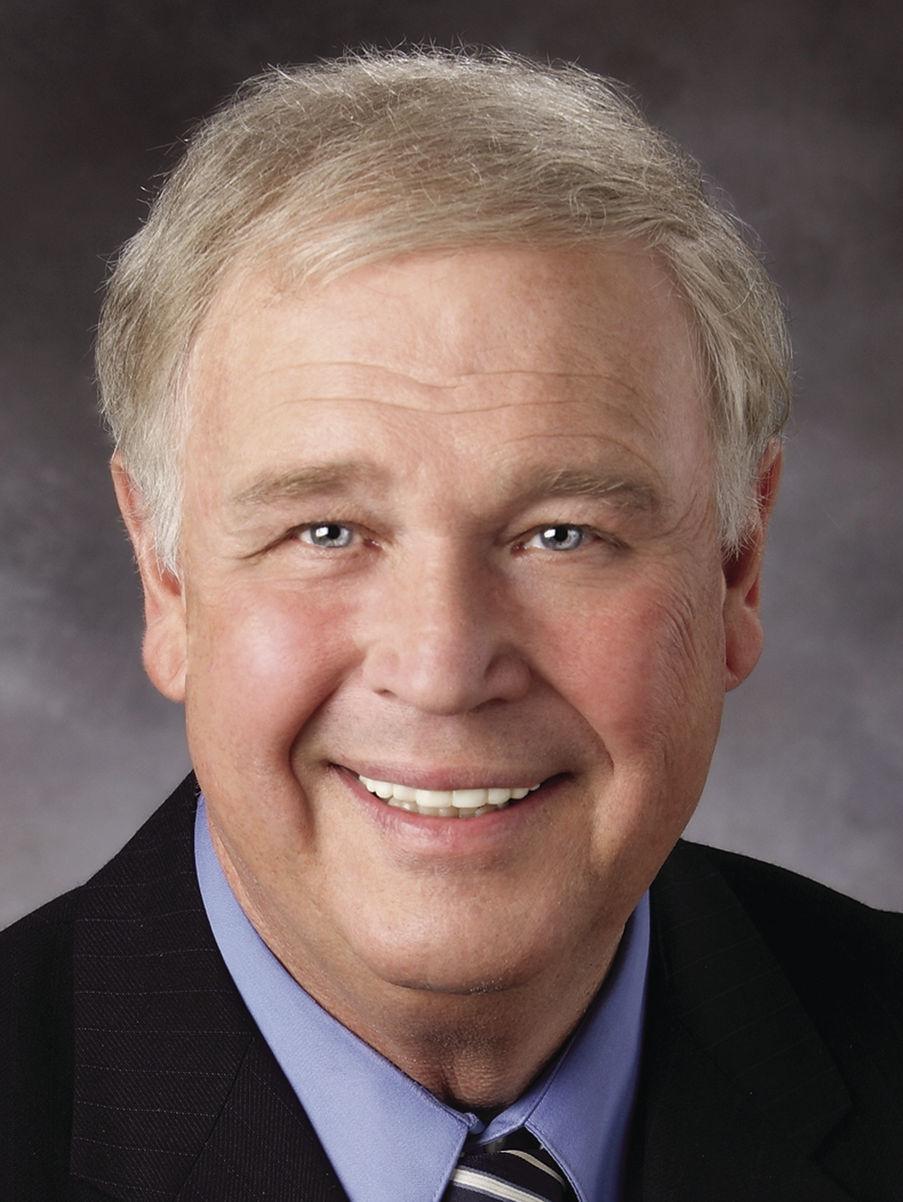
When state lawmakers return to St. Paul this month they’ll have plenty on their plate. In addition to the task of passing a major bonding bill to fund projects throughout the state, they’ll have to decide how to handle a projected $1.3 billion budget surplus and voice their own ideas for legislation.
Sen. Scott Newman, R-Hutchinson, represents District 18 in the state senate. Rep. Glenn Gruenhagen, R-Glencoe, represents District 18B in the state house. Rep. Dean Urdahl, R-Acton Township, represents District 18A in the state house. They shared their priorities for the 2020 session, which is scheduled to begin Tuesday, Feb. 11.
Urdahl would like to continue pursuing improvements to civics education in Minnesota. He believes the model for teaching the subject is inconsistent and potentially lacking in many schools. He introduced a bill last year that would have required civics be taught to juniors or seniors for credit.
“We did not get that into law,” he said. “What we got was that we encourage school districts to have a class for civics for credit for juniors or seniors. I have no illusion that because we urge them they are going to do it. Few changed anything, I would imagine. I would still like to find something the School Board Association and superintendents would agree to that would fulfill my goals. The exact form that takes remains to be seen.”
He has a committee hearing scheduled Feb. 5 and plans to have a dozen people testify about the need for more civics in education.
Urdahl would also like to offer teachers more support and encourage them to stay with the profession beyond the first five years, during which many quit.
“We do not have a consistent model for mentoring teachers in the state of Minnesota,” he said. “We need to give them more support. ... That’s not the only thing (they need), but it’s something we can do.”
Other issues on his mind include flood mitigation and providing more recourse to teachers attacked by students. He would also like to do away with taxes for trading in a tractor to buy another tractor. The trade-in value is currently counted as income.
Newman wants to take a look at how the Minnesota Department of Transportation selects what roads and bridges to fix.
“There is very little input from the public or legislators who are elected by the public, or any transportation groups,” he said. “In 2015, the office of the legislative auditor created a report on the MnDOT selection process and made certain recommendations. I am going to hold a hearing this year on what, if anything, MnDOT has done to comply with the recommendations to change their selection process. ... We are talking $3 billion a year that goes into MnDOT’s coffers. It’s a big chunk of money. I am trying to get a handle on how they decide to spend their money.”
He also wants to address waiting times to schedule a driver’s license examination.
“There are places in the state where you have to wait a month or two to get an exam,” Newman said.
The issue, he believes, can be resolved by allowing a third party to administer tests, instead of allowing only the state Driver and Vehicle Services agency to conduct them. He said allowing a third party to conduct tests for school bus drivers appears to have gone well and helped address a backlog.
“The state would provide the certification for the third-party tester. It would be an independent, private business,” Newman said. “They would do the test and show the results to the state, and the state would issue a license. ... If private businesses can offer driver training, I would think that they would be in a position to be certified to offer proof a person can get their license.”
He’d also like to stop the practice of the state buying land to build testing grounds for driving tests. He believes other properties, such as fairgrounds, can fit the need.
“Why should taxpayers buy a piece of property?” Newman asked.
Gruenhagen wants to address prescription costs. Last session he started work on legislation that would add more accountability for pharmacy benefit managers, and wants to move forward with it. These companies manage prescription drug benefits for insurers, Medicare plans and others by negotiating with manufacturers and pharmacies. Gruenhagen said PBMs can receive discounts from manufacturers but pocket them instead of passing them along.
“I’m not going to paint with a broad brush and say they all are doing that,” he said. “But it’s a major problem in driving up health care costs across the board, especially for seniors.”
He believes reforms to the process will lower prices.
Gruenhagen is also concerned about overprescribing psychotropic drugs to teenagers. He plans to introduce a bill that would study why the United States appears to label more youth as having mental health issues and prescribes more drugs compared to other nations.
“I’m not saying it shouldn’t ever be used,” he said.
Gruenhagen said a study would help paint a clear picture of the situation, and see if more needs to be done.
BUDGET SURPLUS
It’s yet unclear just what can be done with the budget surplus. The projected $1.3 billion could change, and it could be whittled down by inflation.
Newman said that state agencies shouldn’t expect any additional funds, and that if the money is spent it should be used for tax relief instead of government programs.
“I think you’ll see Republicans support some tax cuts,” Gruenhagen said. “I think some of the surplus will be used for roads and bridges, for infrastructure, instead of any type of gas tax increase.”
In some ways, the Atwater-Cosmos-Grove City School Board looks much like it did a year ago, in 2019. Board officers remain the same, with Michael Hendrickson re-elected chairman, Megan Morrison vice chairwoman, Jeanna Lilleberg clerk and Diane Rivard treasurer.
Board committee assignments are also similar. And one of the first items of business of the new year was directing school administrators to look into ways to trim costs and “right size” district staff to reflect projected enrollment and budgetary realities for the next school year.
The eventual “right sizing” will likely look different than it did one year ago, however, when the board trimmed educational and support staff by several positions and added more preschool staff. January 2020 enrollment remains about 40 students more than January 2019, meaning that the district may need to add staff and/or programming or redirect its focus based upon special education needs and the direction students are taking in signing up for classes.
One area of interest is vocational education. On Jan. 27, the ACGC board heard a report from shop instructor Ben Sovacool about trends in the shop department. Currently beginning and advanced classes are offered in welding, woodworking, and computer-aided technology. Sovacool is bringing back a revised carpentry class due to anticipated interest in the construction trades and will add a “supermileage” class in which students build electric and/or alternative fuel vehicles. Sovacool hopes for growing future interest in these classes among both male and female students.
While discussing trends for next fall, Supt. Nels Onstad made note of changing special education and media center needs and a desire to add more instruction in art, math and science at the elementary level. He also hopes to train staff in technology integration. Onstad plans to meet with staff and bring detailed recommendations to the board later this winter, so that any staff adjustments may be made in a timely manner.
School officials also discussed how programs like summer school, child care, and administrative support would be conducted during this coming summer, when most of the elementary school building and some areas of the junior-senior high school building will not be accessible due to construction activity. Some off-site locations may need to be leased, especially in Atwater.
In other action:
- The board changed it policy for accepting donations for curricular and extra-curricular activities. From now on, donations will be accepted through resolutions, not simple motions. Policies on home schooling and the district’s code of ethics were also reviewed and revised slightly.
- In personnel matters, the district signed a food service contract with Alyssa Bergstrom.
- The district’s first snow make-up day was slated for Feb. 5. The next regular school board meeting will be 6 p.m. Feb. 24 in the ACGC High School Media Center.


Vote-by-mail has grown in popularity in Meeker County.
Three Meeker County townships opted for mail balloting in 2016. That increased to seven townships — including first-timers Darwin, Ellsworth and Forest City townships — and three cities who will vote by mail this year.
“One of the pros would be (voters) don’t have to be dedicated to go on election day, their ballots are mailed to them,” County Auditor Barbara Loch, said in explaining the increasing popularity of voting by mail. “Many people take convenience already by early (voting) or absentee. Some poll sites were difficult to meet all the handicap requirements and others, and so this way, they didn’t have to have the poll site buildings updated.”
Residents in the cities of Cedar Mills, Cosmos and Kingston, and in the townships of Cedar Mills, Cosmos, Danielson, Darwin, Ellsworth, Forest City and Harvey will vote by mail in the state's presidential primary, as well as state primary in August and general election in November.
Mail balloting is cost-effective and efficient, especially for areas with a limited number of voters, Loch said. However, there are some challenges. Some people might not receive a ballot, while others are uninformed about the process, Loch said.
Harvey Township Supervisor Chad Kipf said he hasn’t heard any complaints about the mail balloting process since the township made the switch.
Mail balloting is more convenient, Kipf said. “And from our standpoint, my understanding is (it is) saving the township a considerable amount of money ....”
Mail balloting also could encourage more people to vote, Kipf added.
“But I have yet to hear a complaint from anyone as far as having the mail-in ballot,” he said.
It has gone so well, Kipf said, he thinks Litchfield School District should implement a mail balloting process to make it simpler for voters who either live far away or who can’t come to a polling site.
“I wish the school referendums would be mail-in ballots,” he added. “I don't understand why they weren't. I think they would get better (turnout). I think it's a lot easier for people to vote and put it in the mailbox.”
The mail balloting process could raise some eyebrows for some people, Loch said.
“There’s even a few people that say, ‘If you don’t see the (voters) in person, how do you know that they’re the ones that truly filled out the ballot?’” she said. “So could there be (voting) fraud? I would hope not, because they do have to do signatures and do their process.”
Registered voters in mail ballot precincts should have received ballots by Monday, Feb. 3, for the presidential primaries and should follow mailing instructions and deadlines, Loch said. The same process will apply for the state primary Aug. 11.
Voters should closely follow instructions of the mail process, as incomplete ballots will be returned, Loch said.
“So if they were in person, they would likely be guided more through the process. Rather, here, they would have to read the process,” Loch said. “So I guess that would be one of the things that would be adverse. So it’s kind of a mixture.
“Voters can be confident their votes count if they follow the instructions,” she added, “return their ballots timely, drop them off in person if they like, and follow the Secretary of State's website that shows the tracking progress on their ballots from mailing to receipt back in our office.”