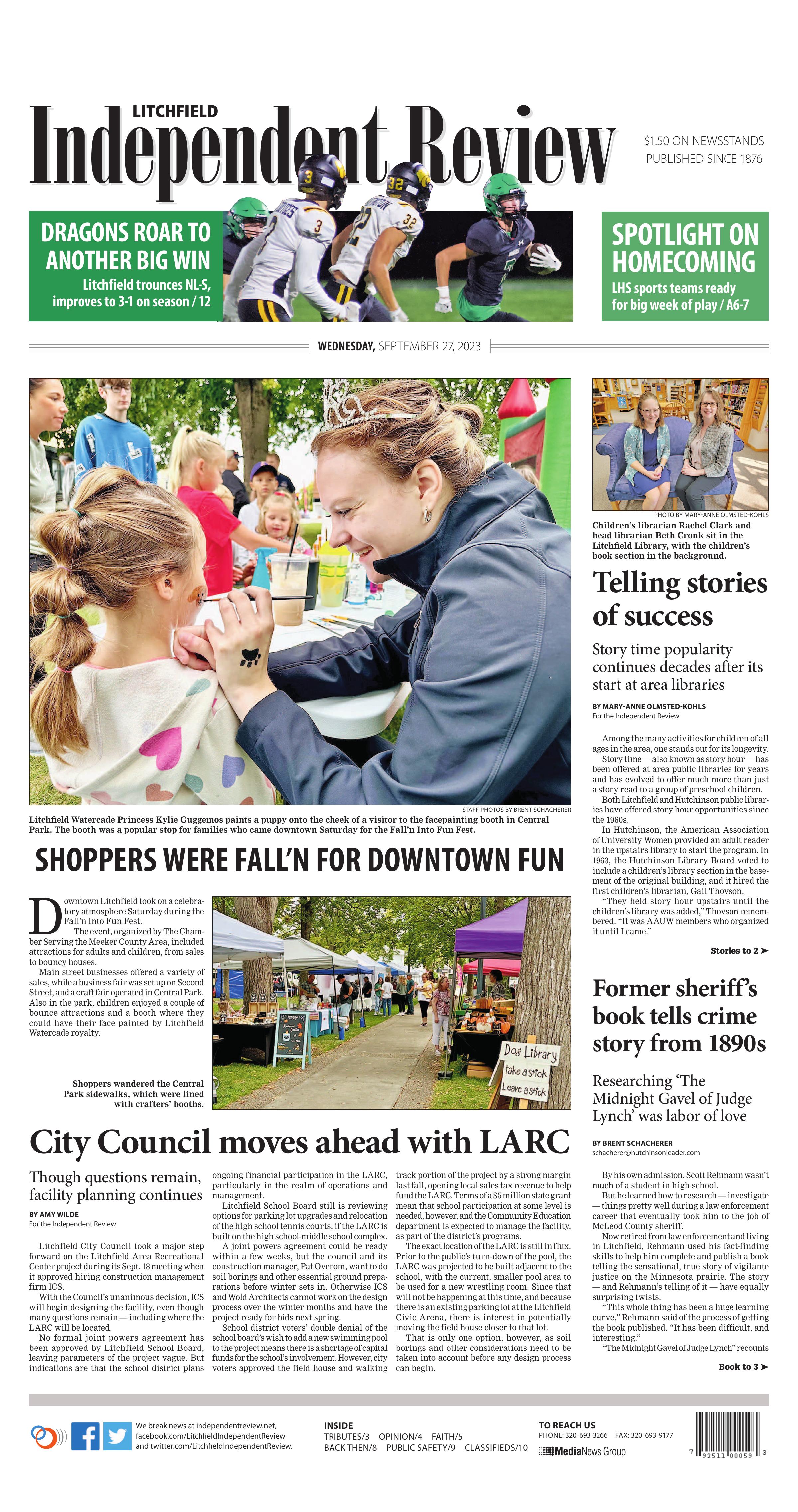
Litchfield Watercade Princess Kylie Guggemos paints a puppy onto the cheek of a visitor to the facepainting booth in Central Park. The booth was a popular stop for families who came downtown Saturday for the Fall’n Into Fun Fest.
Shoppers wandered the Central Park sidewalks, which were lined with crafters’ booths.
Two bounce attractions gave children a respite from the adult shopping fun during the Fall'n Into Fun Fest Saturday.
Bright colors and fall foliage drew a steady stream of visitors to Stockmen's Greenhouse booth in Central Park.
Downtown Litchfield took on a celebratory atmosphere Saturday during the Fall’n Into Fun Fest.
The event, organized by The Chamber Serving the Meeker County Area, included attractions for adults and children, from sales to bouncy houses.
Main street businesses offered a variety of sales, while a business fair was set up on Second Street, and a craft fair operated in Central Park. Also in the park, children enjoyed a couple of bounce attractions and a booth where they could have their face painted by Litchfield Watercade royalty.

Litchfield City Council took a major step forward on the Litchfield Area Recreational Center project during its Sept. 18 meeting when it approved hiring construction management firm ICS.
With the Council’s unanimous decision, ICS will begin designing the facility, even though many questions remain — including where the LARC will be located.
No formal joint powers agreement has been approved by Litchfield School Board, leaving parameters of the project vague. But indications are that the school district plans ongoing financial participation in the LARC, particularly in the realm of operations and management.
Litchfield School Board still is reviewing options for parking lot upgrades and relocation of the high school tennis courts, if the LARC is built on the high school-middle school complex.
A joint powers agreement could be ready within a few weeks, but the council and its construction manager, Pat Overom, want to do soil borings and other essential ground preparations before winter sets in. Otherwise ICS and Wold Architects cannot work on the design process over the winter months and have the project ready for bids next spring.
School district voters’ double denial of the school board’s wish to add a new swimming pool to the project means there is a shortage of capital funds for the school’s involvement. However, city voters approved the field house and walking track portion of the project by a strong margin last fall, opening local sales tax revenue to help fund the LARC. Terms of a $5 million state grant mean that school participation at some level is needed, however, and the Community Education department is expected to manage the facility, as part of the district’s programs.
The exact location of the LARC is still in flux. Prior to the public’s turn-down of the pool, the LARC was projected to be built adjacent to the school, with the current, smaller pool area to be used for a new wrestling room. Since that will not be happening at this time, and because there is an existing parking lot at the Litchfield Civic Arena, there is interest in potentially moving the field house closer to that lot.
That is only one option, however, as soil borings and other considerations need to be taken into account before any design process can begin.

Children’s librarian Rachel Clark and head librarian Beth Cronk sit in the Litchfield Library, with the children’s book section in the background.

Among the many activities for children of all ages in the area, one stands out for its longevity.
Story time — also known as story hour — has been offered at area public libraries for years and has evolved to offer much more than just a story read to a group of preschool children.
Both Litchfield and Hutchinson public libraries have offered story hour opportunities since the 1960s.
In Hutchinson, the American Association of University Women provided an adult reader in the upstairs library to start the program. In 1963, the Hutchinson Library Board voted to include a children’s library section in the basement of the original building, and it hired the first children’s librarian, Gail Thovson.
“They held story hour upstairs until the children’s library was added,” Thovson remembered. “It was AAUW members who organized it until I came.”
Litchfield saw the children’s library established in the mid-1960s in the basement of the Carnegie Library on Sibley Avenue. Under the direction of children’s librarian Gerda Welch, volunteers read to the children during the summer Story Hour.
Story Time — as it’s referred to now — is still as popular as ever at both libraries.
“We average about 18 toddlers and infants on Wednesdays and 25 children on Fridays,” said Beth Cronk, head librarian at the Litchfield Library. The summertime session is a lot looser and has a wide range of participants.”
Litchfield offers two sessions — on Wednesday and Friday mornings. Both sessions are for infants and toddlers accompanied by parent or caregiver. The Wednesday session starts at 10:15 a.m. and is a simpler and shorter class. Friday’s session, which starts at 10 a.m., is longer and includes crafts, paint or clay, sensory bins, music and movement that reinforces the book selection.
Hutchinson has one session, at 10 a.m. Thursdays, that is open to all ages — infant-to-school age, and parents or caregivers are encouraged to attend.
“We have found that it’s a good way for the adults to get know one another, too,” said Katy Hiltner, head librarian at Hutchinson Library. “There is time for them to chat while the kids are busy with their sensory activities.”
Parents also have an opportunity to learn during Story Time, especially ways to build the reading habit in their children.
“Parent attendance is also valuable because we are modeling the way to read to children,” Cronk says. “We can point out challenges, get them outside their comfort zone having fun with their child, give them ideas they can do at home and, of course, recommend books to take home.”
“We believe the more the child sees the parent do the activity, the less intimidated the child will be themselves,” said Rachel Clark, youth services librarian at Litchfield Public Library.
The image of story time with children gathered around quietly while an adult reads to them isn’t the norm anymore. It isn’t that formal.
Elisabeth Kable, youth services librarian at Hutchinson Library, said her role with Story Time is to “have the time be low-key ... laid back. I’m flexible and go with the flow.”
Clark agreed that flexibility is a key during Story Time.
“You can plan and plan, and the kids will throw you for a loop,” she said. “You just roll with it. Who knows ... things may turn out better because of it.”
“The kids love her,” Cronk said of Clark. “She has built up the program, making it fun and accessible for them.”
Story Time tries to reinforce skills children are learning elsewhere. It introduces literacy skills through letter sounds and rhymes. School readiness comes through interaction with other children. Social skills, like taking turns and sharing, also are learned. Hands-on opportunities incorporated with sensory activities can help build STEM skills.
“We try to be outside as much as possible,” Clark said of STEM activities. “We will be doing so as long as the weather is nice through the fall.”
Overall, though, the key aspect of Story Time is introducing children to the library.
“We hope to springboard a child toward books,” Cronk said. “We promote the books and materials at the library that they can take home. We have Discovery Boxes that are kits with music, letters and activity suggestions families can take home and don’t have to find storage for. They can just bring them back to the library.”
“We hope to have children see the library as a fun, safe space,” Hiltner said. “We feel discovering books when they’re young will get children used to them, enjoy them.”
“I see them take ownership,” Kable said. “After a while, the children come to feel they own the library. It is their place.”
“That has always been the focus — to be child centered,” Hiltner said.
“I love having the families and kids come,” Kable shares. “They shouldn’t worry about being on time. Being late is OK.”
“Families don’t have to feel they need to come every week, either,” Hiltner added.

Scott Rehmann holds his book “The Midnight Gavel of Judge Lynch,” which he self-published earlier this year. The book is available at Amazon.book.
By his own admission, Scott Rehmann wasn’t much of a student in high school.
But he learned how to research — investigate — things pretty well during a law enforcement career that eventually took him to the job of McLeod County sheriff.
Now retired from law enforcement and living in Litchfield, Rehmann used his fact-finding skills to help him complete and publish a book telling the sensational, true story of vigilante justice on the Minnesota prairie. The story — and Rehmann’s telling of it — have equally surprising twists.
“This whole thing has been a huge learning curve,” Rehmann said of the process of getting the book published. “It has been difficult, and interesting.”
“The Midnight Gavel of Judge Lynch” recounts the deadly encounter between the McLeod County sheriff and two men traveling through the area on their way to Iowa. With the sheriff, Joseph Rogers, dead, the men try to flee but are pursued by posses and eventually brought back to face trial. But when a trial does not deliver the verdict a riled public seeks, a lynch mob takes matters into their own hands.
Told through the lens of newspaper reports from the 1890s that Rehmann collected over a period of more than a decade, the story reads like a movie script.
“That’s the way my mind worked,” Rehmann said of his reaction when first coming across the story. “It was just all this movie played out in my head.
“I’m a visual person,” Rehmann added. “I’m reading this, like, whoa! Just a lot of different things happening, a lot of twists and turns … then the street justice, mob justice.”
HIS OWN STORY
Rehmann was McLeod County sheriff when he suffered a stroke Aug. 31, 2020, leaving him paralyzed on his right side. He spent three weeks in the hospital and continues to undergo physical therapy. While strength and feeling have returned to his right side, he is not fully recovered.
“It’s not 100 percent,” said Rehmann, who now works at Wings treatment center in Litchfield. “There’s still a lot of weird little neurological things. It’s just enough to be annoying, but not enough that I can’t do things. Like my fine motor skills … it’s hard to do some things (and) I wasn’t really good with numbers in the first place, and that really kind of made it more difficult.”
He spent 14 years as sheriff in McLeod County after having been a part-time deputy and working full-time for the Glencoe Police Department as a school resource officer and patrolman.
It was early on in his term as sheriff that Rehmann’s book began to take shape, mostly as an offshoot of another idea he had.
“I wanted to do a citizens academy, so I wanted to get some interesting stories that I could kind of share throughout the academy,” he said. “I went to the historical center in Hutchinson and started looking at past murders, because those seem to always be the most interesting things to people.”
One story intrigued him more than many others he found during his research — the killing of one of the McLeod County’s earliest sheriffs, and the public outrage that led to the lynching of the two men suspected of the killing.
“I had heard about the lynching and the murder of the sheriff, so I started asking questions about information for that story,” Rehmann said. “People got excited, the workers and volunteers (at the McLeod County History Center), and they started giving me pictures and showed me where to get news articles. All of the sudden, this little thing I heard about really just kind of blew up.
“I found a lot of different murders that happened in McLeod County, but this one was one that, because it was a former sheriff and I was someone that was kind of in the lineage, that’s what made it more fascinating,” he added.
A BOOK TAKES SHAPE
Rehmann didn’t need to think about the story very long before deciding it would be a good book. But he didn’t want to rush it and sacrifice details. So he put his investigative skills — honed throughout his law enforcement career — to use.
It took the better part of 16 years to compile all of the information into book form, but Rehmann believes it was worth it. And of course, he wasn’t only working on the book for the past 16 years. He was working his law enforcement career and then recovering from the stroke.
“Once I started getting the articles ... it just kind of wrote itself,” he said. “Just the way they wrote way back then, a lot of detail, just really big stories. And it really made it across the nation. I was finding stories from New York, stories from Sacramento (California) … just across the nation. It really was a big event.”
Though newspapers provided the bulk of the details, Rehmann wasn’t satisfied with only that. He contacted other sources, including genealogy experts and authors of other Minnesota history books. He tried to track down rumors and family stories handed down through the years about events surrounding the lynching.
“People held on to these stories that have been passed down, and they believe them,” Rehmann said. “It turns out they either weren’t true, or maybe true, but I have no way to prove it.”
Sometimes, the more he researched, the more different branches he found to the story. It was difficult separating fact from fiction in some cases, but he enjoyed tracking down those leads, no matter where they led.
“I love the investigative, detective work in it,” Rehmann said. “You have to search different people’s names and birth dates and where they may have been buried and … I would even call the archives at different colleges where some of the attorneys or judges had graduated to find a picture of them as a student back then.
“I loved that part, just piecing it all together,” he added.