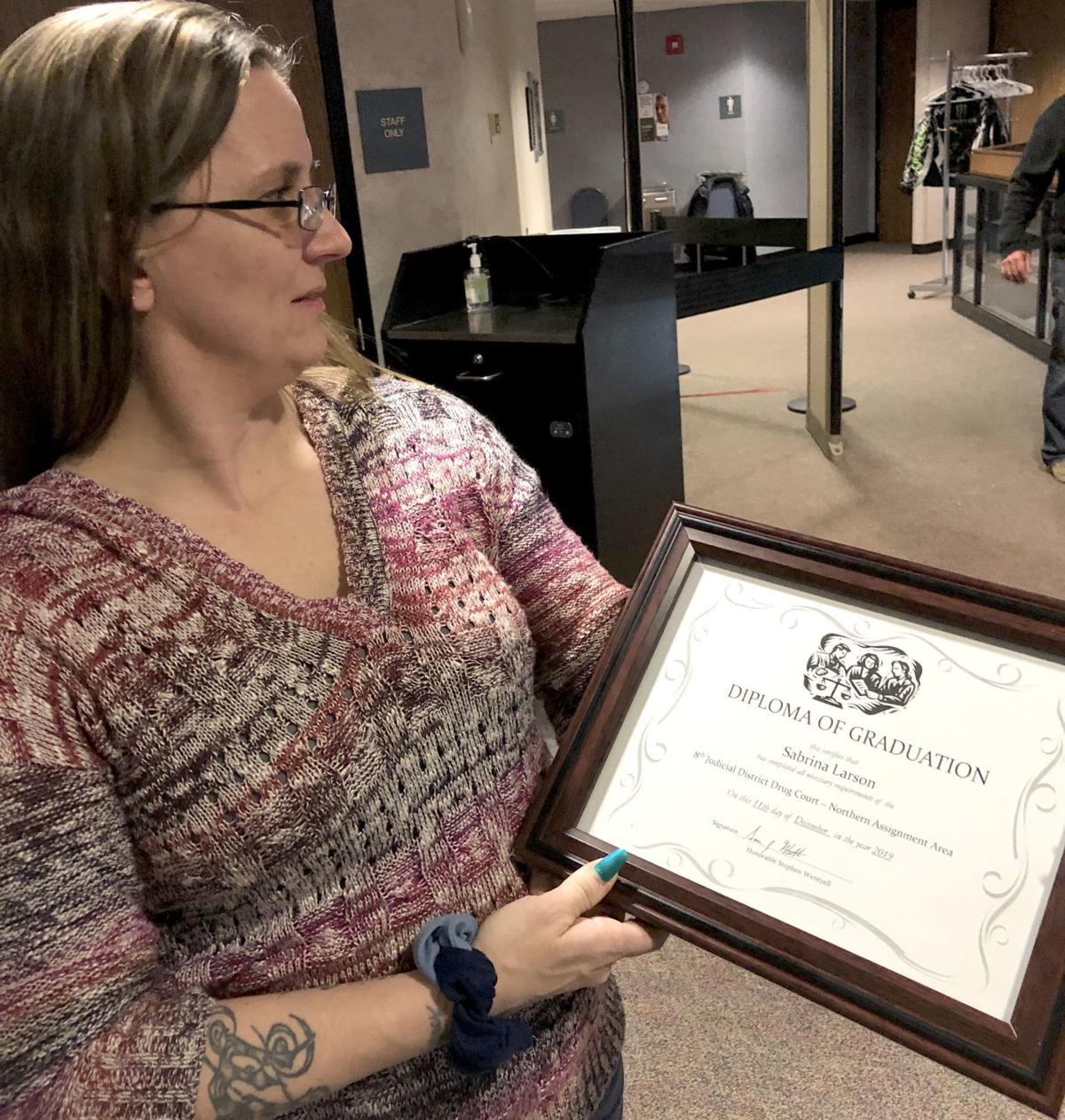
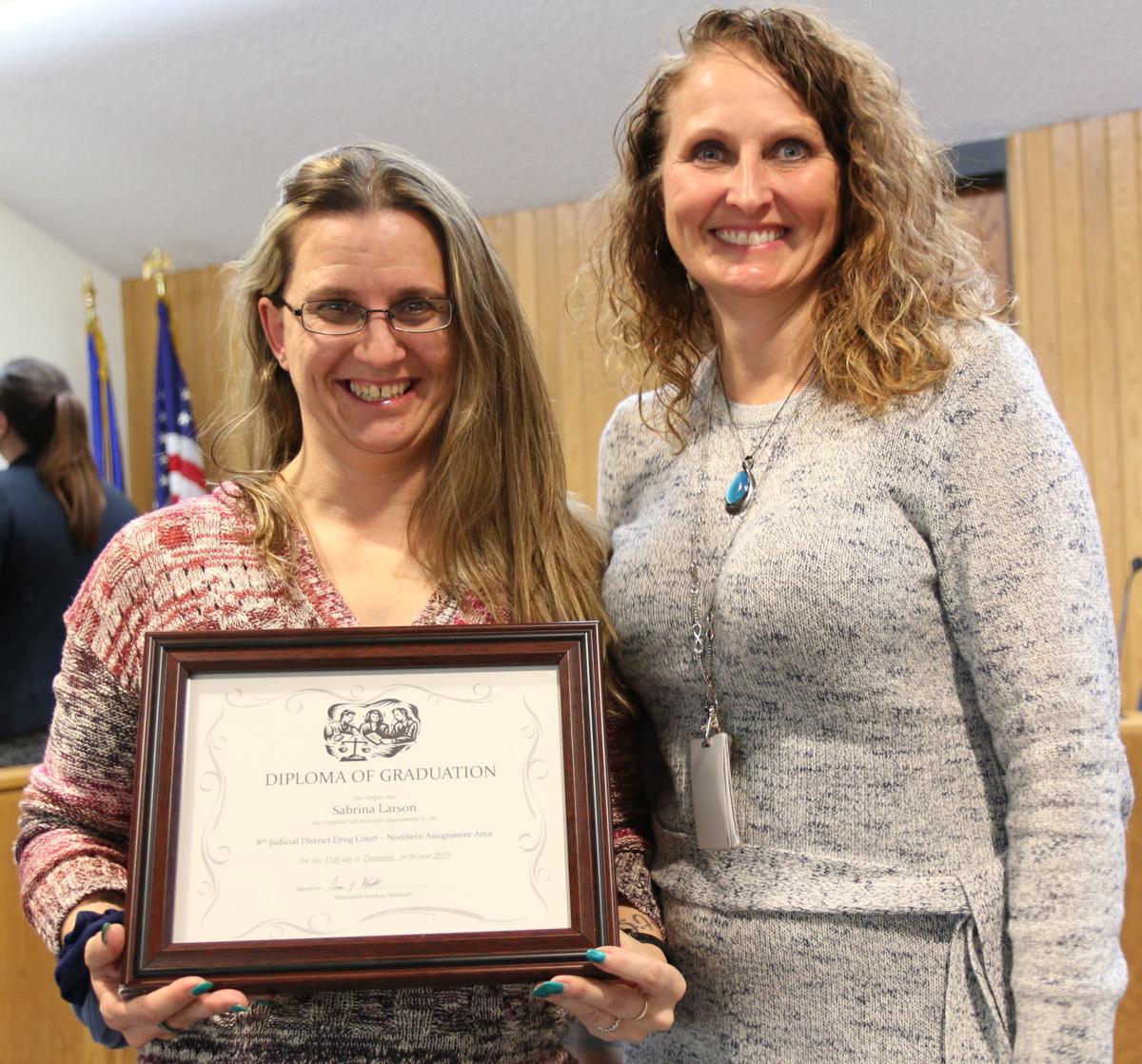


After almost 30 years of drug use and criminal charges, Sabrina Larson said, “Something has (got) to give.”
“I was broken, I was defeated,” Larson said, “because I was. I felt that way. My life had become unmanageable. I dropped out of school. I even have stuff on my juvenile record. I just struggled really hard.”
Her life was like a never-ending cycle, and the Litchfield resident had enough. She wanted more for herself, and she wanted her son and daughter to be proud, so she enrolled in Eighth Judicial District Drug Court.
“When I decided to do drug court, I was kind of leery about it,” she said, “but I knew I couldn’t do it myself and if there was something that would help me — this had to have been it.”
To her surprise, by participating in drug court she’s maintained sobriety for 1,051 days, obtained her GED, held a job for more than two years, and graduated a week ago from drug court.
Drug court is an 18 to 24-month program that seeks to help chemically dependent individuals who might be at higher risk of reoffending, through intensive supervision and oversight. The program includes phases that need to be followed by participants such as treatment, establishing in the community, job and housing stability, and ultimately living a lifestyle of recovery.
Karon White, an Eighth Judicial District treatment court coordinator, said this year marks the fifth year since treatment court began in the area, and Larson is the 31st graduate of the program. Of the graduates, 74 percent haven’t committed serious new crimes, and 57 percent haven’t relapsed, since their participation in the program.
“At the time of entrance into the program,” White said, “19 graduates did not have a valid driver’s license, 12 didn’t have their high school diploma or equivalent, and 23 were unemployed. At the time of graduation, 17 had their driver’s license, eight had obtained their high school diploma or GED and 22 were working at least part-time at the time of their graduation.”
“You have to want it,” to successfully change, Larson said.
When Larson started working at Bargains and Blessings, a thrift store in Willmar, she requested being placed in the back of the store to do stocking and organizing items, Edith Ryder, co-owner and manager, said.
Soon, Ryder and Becky Zondervan, co-owner of Bargains and Blessings, discovered placing Larson at the back of the store was a mistake.
“She’s the most social person you could ever meet,” Ryder said. “And she didn’t know that about herself.”
Since Larson exhibited a good work ethic over the years at Bargains and Blessings, Ryder and Zondervan decided to hire her.
“We’ve just placed a lot of trust in her, and she’s responded,” Ryder said. “She’s just blossoming. It’s a lot of fun. Anytime we take pictures, we’re dressed up in some silly customs right in the middle of it.”
Graduating from drug court is intimidating, Larson said, because she won’t have the same accountability and structure that have helped her.
“I’ll probably end up going to more narcotics anonymous meetings,” she said. “I’ll reach out with my sponsor more and just keep going to sober functions. I don’t talk to people who use anymore, and it doesn’t bother me.”
As for associating with friends on Facebook who may use drugs, she’ll say hello on the platform, but won’t interact with them in real life, she said.
“I think if people are sick of the lifestyle and who are in trouble with the law, if they have a chance to get into drug court they should," Larson said. "They got to truly want it, they got to truly be ready or it’s not going to work.”