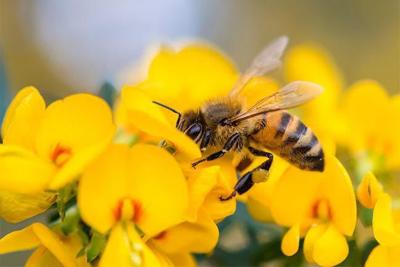
More than 300 different species of bees call Minnesota home. Worldwide, the number is more than 20,000.
And yet pollinators — especially bees — have seen massive population declines in recent years due to habitat loss, pesticide use, parasites and disease.
Through these U of M resources and by taking few simple steps in a yard and garden, anyone can help bees and other pollinators survive and thrive.
Pollination basics
More than one-third of the world’s crop species depend on bee pollination, an ecological service valued in North America at more than $20 billion a year. But bees don’t care about the money — they’re just interested in finding flowering plants that supply them with pollen (protein) and nectar (carbohydrates), so they can keep doing what they do.
Beyond bees, other insects and animals like wasps, flies, ants, butterflies, moths, beetles, some birds and even bats are pollinators. Play a part in their revival by planting and maintaining a lawn or garden that is hospitable to their — and humankind’s — survival.
Flowers for bees
Some flowers are better at providing pollen and nectar to support bee nutrition. Sunflowers, zinnias, catmint and purple coneflower are just a few that are attractive to bees and can be easily integrated into most Minnesota landscapes. The University of Minnesota maintains a full list of plants and flowers that allow Minnesota’s bees to thrive.
Meanwhile, even a change of perspective can help bees. Consider that dandelions, often thought of as a weed, are a first source of nectar for pollinators—most notably Minnesota’s native bumblebees, which emerge hungry in early spring.
Bee lawns
Bee lawns are starting to get a lot of buzz. The UMN has researched flowers that bees love and can be added to a lawn without drastic changes in care routines or aesthetics. (Anyone will be able to still mow, play ball and picnic on a bee lawn.)
U of M research has shown that adding Dutch white clover, self-heal and creeping thyme into a lawn will attract many kinds of pollinators, including honeybees, bumble bees and solitary bees. Picking up the plants at these locations (Otten Brothers, JK Landscape and Construction, Organic Lawns by Lunseth, Eggplant Urban Lawn Supply or Leitner’s Garden Center) will give 5 percent of sales to funding the U of M Bee Lab.
Learn more about managing bee lawns by visiting tinyurl.com/umnbees or visit a bee lawn demonstration area at the University of Minnesota Landscape Arboretum.
Resources for people and pollinators
Take your pollinator knowledge to the next level through short classes at the U of M Landscape Arboretum, beekeeping short-courses and even pollinator field trips for school-age children.
Anyone can take a field-trip and visit the U of M Tashjian Bee and Pollinator Discovery Center, which helps visitors of all ages learn all about bees, butterflies and other pollinating insects.
For more information about the UMN Tashjian Bee and Pollinator Discovery Center or UMN Bee Lab, visit beelab.umn.edu.