

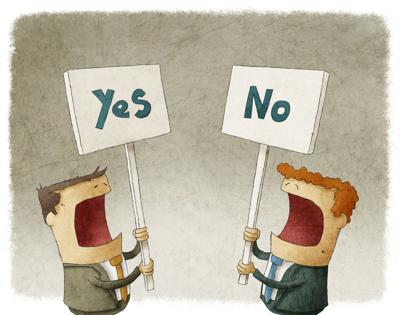
There is little doubt that the current political climate can be described as a culture of contempt when supporters of the left or the right voice attacks on the personal life, integrity and morality of those representing the opposite side.
Arthur C. Brooks has written a book entitled “Love Your Enemies” in which he explores the ways decent, fair-minded people can view those with political opinions that are different from our own. He points out that we should, as in some past times, try to understand those we disagree with, without being disagreeable.
If you express views that tolerate even a slight understanding of the views on the other side, you may be considered a hateful bigot, a fool or worse by those who, for the most part, you agree with. The divide between “progressive” and “conservative” ideas seems almost insurmountable.
For example, the views expressed on abortion range from an acceptance of killing a child after a live birth to a prohibition on interfering with the beginning of life processes moments after intercourse. Insofar as a woman being responsible for the control of her own body, I think we can all agree, but the issue is when does the new life being generated within her body have rights as well. Not to mention the responsibility of the male involved with the pregnancy and potential child care.
Another contentious issue is using tax money for the “welfare” of some people. Is it really appropriate to guarantee a certain minimum dollar amount to every living person just because they are alive? Or is it more fair to require that able-bodied people work at some task that benefits the community in order to receive government money?
Again, the issue is that we as a community and nation are willing to provide tax money to keep people from starving or freezing to death, but observing that many people take advantage of any charity provided in order to avoid work is disturbing. Finding a middle path that takes care of the truly needy yet punishes those who would cheat the system is a worthy goal for both sides.
Way too many topics fall into the “not politically correct” category and result in name-calling because one side thinks the other side is evil or corrupt because they do not support their view of a problem. Climate change is one of those issues where it is difficult for people to even talk about it in a civil way because they disagree as to the cause of whatever climate issue we are addressing.
Are forest fires in California, which has experienced a dry spell, the fault of the rest of the population using fossil fuels, or is it sunspot activity that is an uncontrollable event having nothing to do with mankind’s emissions of carbon dioxide? It matters not how many scientists advocate for one side or the other. The issue can only be resolved by seeking the true answer to the question, providing sufficient proof to convince both sides.
There are many more issues that divide the so-called “progressives” from the so-called “conservatives.” Even those names can be a source of contention since we all want to think of ourselves as believing in positive “progress,” such as “Make America Great Again,” and at the same time “conservative,” as in the Green New Deal advocating conserving the resources of the Earth.
There is obviously no easy answer to the great divide, but a bit of love and understanding would go a long way toward political solutions, as opposed to a deadlocked hate for each other.

