


It seems that almost everyone has a story to tell about distracted driving.
We found that out when Crow River Media reporter Sarv Mithaqiyan asked a question via social media regarding how people felt about Minnesota’s new hands-free driving law.
In a relatively short period of time, he received messages from several people who openly shared the distracted driving habits they have witnessed. Some of the stories were downright frightening.
All of them offered an illustration for why the new law, which goes into effect Aug. 1, is so badly needed.
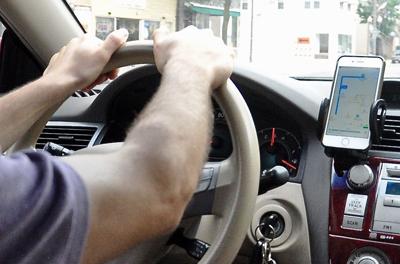
State law previously banned texting, using email and web browsing while driving, but the new law requires drivers to only use cell phones in “hands-free” mode for voice-activated calls. “One-touch” functions, such as navigation prompts, music, podcasts and other audio-based content, will still be allowed if accessed without holding the device, typing, or scrolling. The law does not apply to drivers in legally-parked vehicles or to law enforcement and emergency personnel. The penalty for violating the law is a gross misdemeanor, carrying a $50 fine for the first violation and a $275 fine for subsequent violations.
According to Minnesota Department of Public Safety’s Office of Traffic Safety, from 2013 to 2017 the state saw 269 inattention-related traffic deaths and 1,103 inattention-related serious injuries.
All told, the economic impact of those inattention-related deaths and injuries was estimated at nearly $400 million.
Closer to home, Meeker County saw two deaths and three serious injuries related to inattention-related crashes from 2013-2017. McLeod County saw five deaths and 13 serious injuries. Between the two counties, distracted driving was responsible for nearly 22 percent of all fatal crashes and almost 16 percent of serious injuries during that five-year span.
All because a text or phone call, or some other distraction, seemed more important than keeping eyes on the road and hands on the wheel.
“More and more Minnesotans are being seriously injured or killed because of irresponsible, distracted driving,” state Sen. Scott Newman, author of the hands-free law, said earlier this year. “Drivers have a responsibility to themselves, their passengers, and the others on the road. We need to reinforce just how dangerous cell phone use while driving can be, and that’s what this bill is intended to do.”
We’ve developed bad habits since the inception of the cellular telephone. Because we have it, sitting right next to us in the car, we have come to believe that we must use it. That the incoming call or text must be answered immediately.
Remember when talking on the phone while flying down the highway seemed, well, needless?
Minnesota’s hands-free law does not end the car-bound phone conversation. But it does aim to decrease the distraction by removing the phone from drivers’ hands.
For some, even this will take some getting use to. Bad habits are hard to break.
“This new law is going to be an adjustment for a lot of people and I hope many drivers already have made the switch in anticipation,” state Rep. Dean Urdahl said in a news release earlier this week. “Ultimately, it is our responsibility to keep our eyes on the road, and it will be interesting to see if, over time, this new law cuts down on incidents caused by distracted driving.”
He is right, of course. We don’t know with certainty that “hands-free” will be the game changer everyone wants it to be.
But eliminating distractions while behind the wheel can’t be a bad thing.
It seems to us to be a common-sense, life-saving thing.


