

There was cause for excitement. It was May 31, 1862, and for the first time, Union troops were on the outskirts of Richmond, Virginia, the capital city of the Confederate states.
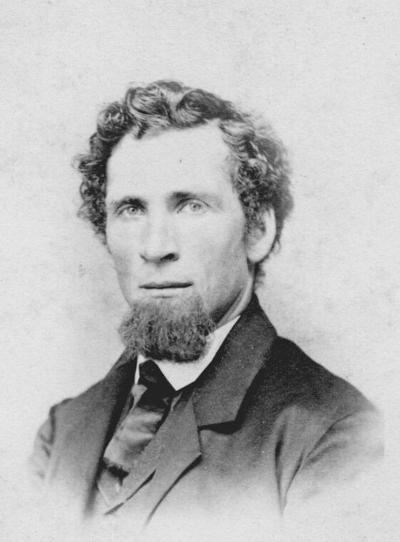
The troops were under the command of Union Gen. George B. McClellan and facing up against Confederate Gen. Joseph E. Johnston. The Union troops were optimistic from having won a few smaller skirmishes en route to Richmond after losing a devastating battle in Manassas the previous year. Among those enthusiastic Union soldiers was a young McLeod County man named Lloyd Pendergast, the first man in McLeod County to enlist in the Union Army.
Just a day prior, Pendergast wrote to his brother in Hutchinson: “We are now fifteen miles from Richmond near Chickahominy Creek. The advance is within a short distance of the city. McClellan’s headquarters are six miles ahead of us. Porter’s division had quite a brush with the enemy a few days ago, the Federal troops coming out victorious as usual, routing the rebels and taking possession of the Richmond and Fredericksburg railroad. … We heard the firing all the afternoon and when at night the news of the victory came in, cheer after cheer went up from every regiment around here.”
The Confederates were on the retreat toward Richmond, yet Johnston knew his army could not defend a prolonged siege of the city, as the Union would be able to continuously bring in fresh troops from the Potomac. In a bold move, Johnston chose to end his retreat and attack the Union lines outside of Richmond.
The attack plan was complex to say the least, and poorly executed by the Confederates. To make matters worse, troop movement would be greatly slowed due to a severe thunderstorm that passed through the night before, turning the roads to mud and washing away a Union-controlled bridge that would serve to get Union troops across the Chickahominy River into Richmond. On the Federal side, Union commanders strengthened their lines as best they could and readied themselves for the attack. Most believed that the Union would find victory and take Richmond, effectively ending the war in its tracks.
During the battle, Lloyd Pendergast wrote to his brother: “We are here on the battlefield ready for another fight, but I am inclined to think the rebels got enough of it the last time and will let us alone for a while. While in camp we heard heavy firing in the direction of Richmond and learned that it was caused by a large number of rebels attacking Casey’s division, which was the only one there across the Chickahominy. Bottom’s bridge had been carried away by a freshet and the enemy thinking we could not bring reinforcements, conceived it would be a mighty fine thing to surround what troops we had on that side and take them prisoner. But as it happened, another bridge was completed a few miles upriver, so before the day was over, we had a large number of fresh troops across. … We arrived on the battleground and formed the right wing just in time to prevent a flank movement of the enemy, which might have given them a victory. Pickett’s battery came up next and was brought into position on our left, supported by the rest of our brigade. They had scarcely got into line when they were fired on from the woods. Our men were drawn upon the open ground close to the woods. From then until dark there was continued crash of musketry and blaze of fire all along the line. The din was so great we could not hear our orders.”
On the first day of the battle, Johnston was severely wounded and taken from the field. He was eventually replaced by Gen. Robert E. Lee, who was put in command of the entire Army of Virginia by the end of the day. The following day, the Confederates resumed their attack but retreated by mid-morning, closer to Richmond, and settled in for a defense. The fighting stopped.
Both sides claimed victory, but the Confederates likely held the upper hand. Lee began strengthening his army, and within 90 days had driven McClellan and the Union forces away from Virginia, turning the tide of the Eastern theater and putting a Union victory of the war into jeopardy.
As for Pendergast, he would continue to fight with the First Minnesota in several battles, including Savage Station, Malvern Hill, South Mountain, Balls Bluff, Battle of West Point, Peach Orchard, White Oak Swamp, Vienna and Antietam. In October he was transferred to a cavalry unit and fought in Ashly Gap, Fredricksburg, Falling Water, Charlottesville, Todd’s Tavern, Hanover, Thoroughfair Gap, Brandy Station, Hagertown, Wilderness and Meadow Bridge.
In June of 1864, when his three-year enlistment was up, and with a Union victory looking possible, Pendergast was honorably discharged from the Union Army. He returned to Minnesota and worked as a custodian at the state capitol. He eventually moved to Bemidji and engaged in real estate. At one time he became a candidate for lieutenant governor. He passed away Oct. 17, 1917.
His fame in McLeod County, as an original settler and war hero, lives on today.


