

June is ending and July is upon us. For many that means summer is here.
July is the month of family vacations, backyard barbecues, trips to the lake and, of course, a good old ball game. Scarcely does one think of July, however, without first thinking of the Fourth of July — Independence Day.
We all know the basic story of our nation’s independence from Great Britain, but few know the particulars that made the declaration such an astounding statement. In addition, few know the particulars that lead up to the declaration, and not all are aware of the specifics that were withheld from the declaration or edited out in the final draft to appease all 13 colonies. For that, there is more to the story.
The Declaration of Independence is straightforward. In an assertion to King George III, Monarch of England, the Continental Congress of the 13 colonies laid out their grievances against Great Britain and declared their independence from that nation. In a nutshell, the colonies were freeing themselves from taxation without proper representation in British government, as well as imposed tax hikes that essentially paid for Great Britain’s foreign endeavors. Other objections were Great Britain’s conscription of American citizens into the royal army and forcing colonials to give quarter to British troops.
Declaring independence from Britain was the last step on a long road of colonial actions that were leading toward a departure from the rule of King George. The first seeds of political friction between the colonies and England began in 1651 when the English government began regulating trade into the colonies.
In 1678, colonial militias, primarily ill-equipped settlers, were drawn into King Philip’s War, an armed conflict between Native American tribes of which some were allied with the colonials. The colonial militias fought in the war without any assistance from England and thus began to form an identity apart from people in England.
Following King Philip’s War, colonials were conscripted into the British armed forces to fight in three armed conflicts between England and France. Many colonials resented the loss of American lives in the conflicts as well as England forcing the colonists against neighboring indigenous nations that allied with the French — some of which had friendly relations with the colonists. Making matters worse, Great Britain imposed heavy taxes on the colonists to pay for the wars with France, citing costs for protection against the French and their indigenous allies. Colonists viewed this as no less than a shakedown by the British Parliament.
Colonists began clamoring England to grant them a form of representation in the British Government — citing no taxation without representation, yet they were denied. In 1768, British troops were sent to Boston to quell unrest there, an act that ultimately led to the Boston Massacre in 1770.
The colonists retaliated through a series of successive defiant acts against Britain such as the Gaspee Affair in 1772 and the Boston Tea Party of 1773. In 1774, British Parliament passed the Coercive Acts (Intolerable Acts in America), which acted to punish several colonies for their participation in both the Gaspee Affair and the Boston Tea Party. As a result, the colonies formed the first Continental Congress and convened in 1774. The congress organized a boycott of British goods and looked to petition King George to repeal the acts passed by Parliament. Open warfare erupted the following year at Lexington, and the American Revolution began.
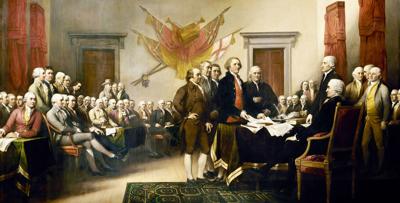
Though the colonies were fighting with England, many still favored patching relations with King George and returning the colonies to Britain. By 1776, however, it was apparent that mending relations was no longer an option. A Second Continental Congress was formed, and a declaration of independence was drafted.
Thomas Jefferson was assigned as the principal author of the document. Interestingly, Jefferson, a slave owner from Virginia, penned a portion of the declaration to condemn the slave trade and criticize Britain’s involvement. He asserted that the rights of men extended to those who were forced to the colonies under British rule and that the trade was forced on the colonies to a point where elements of the colonial economy became dependent on it. Though Jefferson made an impassioned anti-slavery statement, Congress edited it out of the declaration to appease the colonies, which were deeply dependent on slave labor.
With a final draft in place, the Continental Congress voted to declare independence from Britain on July 2, 1776. Two days later, it became official, and the United States of America was born.


