

”Mrs. Ferdinand Luedtke of this city was pronounced dead by the physician last Monday, of apoplexy of the heart. The funeral was to have been held yesterday and the remains were taken to the German Lutheran church in Acoma, a large number of relatives and friends attending.”
— Hutchinson Leader, April 6, 1906
The death of Mrs. Ferdinand Luedtke was tragic, yet nothing out of the “ordinary” when it came to meeting a demise. She was 64 years of age and had met with a terrible accident. Though the exact cause of her accident isn’t entirely known (at least by this historian), it was reported that her death came rather suddenly and there was little anyone could do to revive her — even in the days of limited medical methods of doing so. That being the case, the physician who looked her over pronounced her dead.
As is still common today, the remains of Luedtke were taken to the church where friends and relatives could say their last goodbyes and honor her memory. Officiating this final farewell was the Rev. J.C. Albrecht. The clergyman looked over the body, and though he was no physician, disputed the claim that Luedtke was dead. Upon inspecting the remains, Albrecht observed that there was still color in the face and lips of the supposed deceased. The minister, feeling that Mrs. Luedtke was not dead, refused to officiate the service.
Albrecht had reason to be concerned. Though it’s hard to fathom in 2022, there was a time, not so terribly long ago, when it was believed that the supposed “deceased” were indeed buried alive. Today, through a myriad of methods, doctors can easily decipher if a person has passed on to the next life or not. In fact, declaring death has become a straightforward process. Physicians in the 19th century and prior, however, often had to rely on far more rudimentary methods to declare death — the gold standards were as simple as touch and smell.
A “home-remedy” style method was to tie a string around a finger of the supposed deceased, if the finger turned white, the person was dead, if the finger turned blue, blood still flowed through the veins and the person was alive. Doctors would even go so far as to stick the deceased finger in their ear to detect any sound of a pulse.
As a final means of detecting signs of life before a burial, family and friends would gather round the body of the supposed deceased and watch over them a day prior to burial. They were waiting for the possibility that the person may “wake,” which of course is where the classic wake tradition of today stemmed from.
With such simple means of identifying death, there was a real fear of being buried alive. In fact, there are stories from the past of this happening. One amusing, though macabre, story is of a Cornish countess who was buried with a valuable ring on her finger in 1761. A servant who knew of the ring’s value decided to exhume the “corpse” to steal the prized jewelry. Once brought to the surface, however, the countess came back to life. The servant reportedly ran wildly. The Countess Emma of Edgcumbe lived on until 1807.
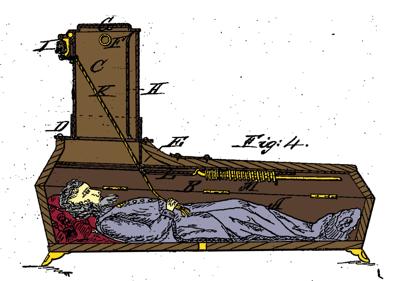
With a real fear of being buried alive, Victorian era “safety coffins” became a way for the dead to signal that they were not dead yet. A cable ran from the coffin to the headstone and was attached to a bell. If the “deceased” came to life, the bell could be rung to alert anyone near that a live person was buried below. Though the idea could put people at more ease about being buried alive, there is no record of a safety coffin saving someone’s life.
Back in Hutchinson, the body of Mrs. Ferdinand Luedtke was brought from the church into a nearby schoolhouse where it remained until family, friends, physicians, reverends, or anyone else would be satisfied that she had indeed passed on to the next life, which she had and was later laid to rest.


