
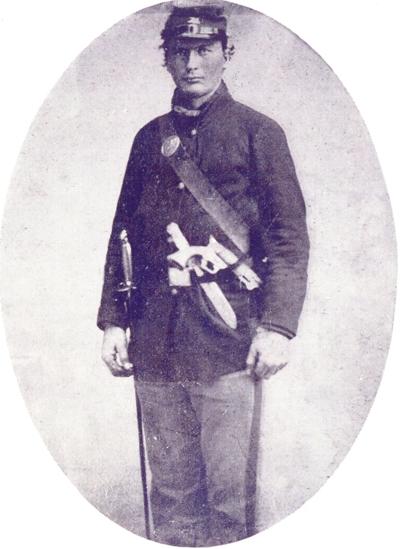

EDITOR NOTE: This is Part 2 of a series of history columns about Glencoe Medal of Honor recipient Axel Reed, who fought in the Civil War. Click here to read Part 1 of this series.
Axel Reed witnessed some of his first real horrors of war at the Siege of Corinth. From May 10, 1862, through the end of the battle, Reed stood in picket lines as well as other duties. He, as did many Union soldiers, felt that leadership of the Army of the Potomac lacked the will to deliver a fatal blow to the Confederates.
Through many of the Union’s early victories, Rebel soldiers were given ample time to evacuate their position safely and regroup to fight another day. In the case of Corinth, after the rebels pulled out, Reed exclaimed, “a poor empty town was our reward … . We marched against the enemy in a leisurely manner, allowing the rebels time to gather all the forage, provision and plunder they desired.”
“After nearly two months’ skirmish fighting, building breast works, (and) trenches, the rebel army evacuated Corinth and sneaked away one night, May 29th, and that evening the rebels kept up a beating of drums which sounded close to our lines,” Reed wrote in his diary. “A brass band came out to our front about 11 p.m. and played ‘Dixie Land.’ May 30th, the morning was bright and warm as summer. ... Every man felt that he had a great duty to perform and that he might not see another so bright a morning.”
Reed’s next taste of warfare would come in October 1862.
“October 8th, My division was allowed to go in and support a battery that was actively engaged. … Fighting commenced early in the day. … We took position on the top of a hill, close behind Loeder’s Battery, which put deadly fire on the enemy,” Reed wrote. “We could hear the rebels yell as they charged. The balls fell thick around us. One grape shot striking close to the flag staff to my right. … The rebel army retreated during the night and made back to Tennessee with much plunder and loot. Nearly every officer and enlisted man became disgusted if not enraged at Gen. Buell, as he was openly accused of being a rebel sympathizer. ... He was soon relieved by Gen. Rosecrans. … We then marched southwest to Galatin, Tennessee.”
Union forces, including Reed, under the command of Rosecrans, marched into Tennessee and skirmished with the Confederates there for the remainder of 1862 and into 1863. As the spring turned to summer, little had changed but the weather.
“June 25th, It rained all day long, hard, and during the skirmishing. Laid down in wet clothing at midnight with nothing but a rubber blanket for shelter,” Reed wrote. “We marched to our fate with the rest of the brigade as soon as it was light. It rained about all night, but soon after we started (marching) it poured down in torrents. … June 29th, … We drove the rebel skirmishers back while a sharp fire was kept up and after driving them back three quarters of a mile, we fell back to our first position. … It began to rain about noon and poured down, wetting us to the skin. June 30th, Laid in camp all day.”
By July 1863, Reed was orderly sergeant whose duties were to oversee the drawing of proper rations to his men. He wrote: “Have to live on mush with very little meat and salt. We have never been this short of rations before.”
Sgt. Reed was informed by some of his men that they had seen rations being issued to rebel citizens and rebel deserters, which enraged him as he believed the rations belonged to his men. Reed made a public complaint to his commanding officers about the rations, as well a complaint against a superior officer whom Reed believed was behind the issuing of giving rations to the rebel deserters. Unfortunately, complaining about a superior went against protocol, and on July 20, 1863, First Sgt. A. H. Reed was arrested and kept in close confinement until further notice.
Though he was shackled and jailed, it would be here that Sgt. Reed would perform his first act that would eventually earn him the highest honor bestowed upon a soldier.
To be continued.


