There’s something remarkable about the change of season. The spring melt, the summer warm-up, or the amber edge of a green leaf in September — all of these are the clues of change coming, a sign that the land will soon transform into something entirely different. Of all the change of seasons, perhaps one that is often overlooked is the shift of autumn to winter. I suppose it’s not the most popular as it signals cold weather on the horizon, but for those select few of us out there, the change from fall to winter is one of the most special times of year. The leaves have gone, the blackbirds have flocked together like swarming insects, and even on the softest of “Indian Summer” days, the mornings are frosty and brisk. It’s November, and winter looms ahead.
November, of course, recalls to mind the holidays and family. For many of us, it also means the dawn of deer season — that time of year when outdoor enthusiasts, bundled in orange, flock to the woods and the swamps in search of a buck. Today, people need not travel far for a deer hunt as the whitetail abounds in our proverbial backyards. It wasn’t always like that, however, as years ago when the deer population was sparse in much of Minnesota, hunters far and wide packed gear into their four-door sedans and drove to the desolate backwoods of Northern Minnesota — an army of red flannel donned soldiers heading to the forest.
Back in 1938, five Hutchinson businessmen had their sights set on adventure in the Northwoods. Their names were Walter Spannaus, 39, proprieter of the Spannaus Drug Store; Lyle Schoeneman, 33, co-partner of the Square Clothing Co.; Frank “Babe” Ruth, 28, manager of the A&P store; Lewis Jergens, 28, local Plymouth dealer; and J.H. Julig, vice president of the First National Bank.
Together, they left Hutchinson in a light-hearted mood on a Sunday morning in preparation for deer hunting “Up North.” They loaded themselves down with a week’s worth of supplies and headed up to Big Falls, arriving at 4 p.m. after a long journey through the backwoods. Upon arrival, they met with two game wardens who guided them to a destination deep in the woods. They would be staying in a makeshift shack, or trailer. The wardens planned to stop in the following day to show the men the surrounding area and where the best hunting spots would be.
Nobody really knows what transpired between the warden’s departure and their return the following morning. Two wardens arrived on the scene and noticed immediately that the trailer was uncommonly quiet. They tried to enter, but found that it was locked from the inside and were forced to break in. What they saw was horrible, all five hunters lay on the far side of the trailer with only Julig showing any signs of life.
The wardens could tell straight away that four of the men had died from carbon monoxide poisoning. They brought Julig outside and performed artificial respiration on him until help arrived. Julig was then rushed to the hospital.
The men had installed a little gas burner in their shack and though it could only be guessed at, they either left the burner on overnight, or lit it early in the morning to take the cold November chill out of the air. Either way, the flame ate the oxygen from the room and filled it with carbon monoxide. It was assumed the latter since Julig was still alive.
Word went back to Hutchinson of the tragedy — most hoped that the story was a rumor, but it turned out to be true.
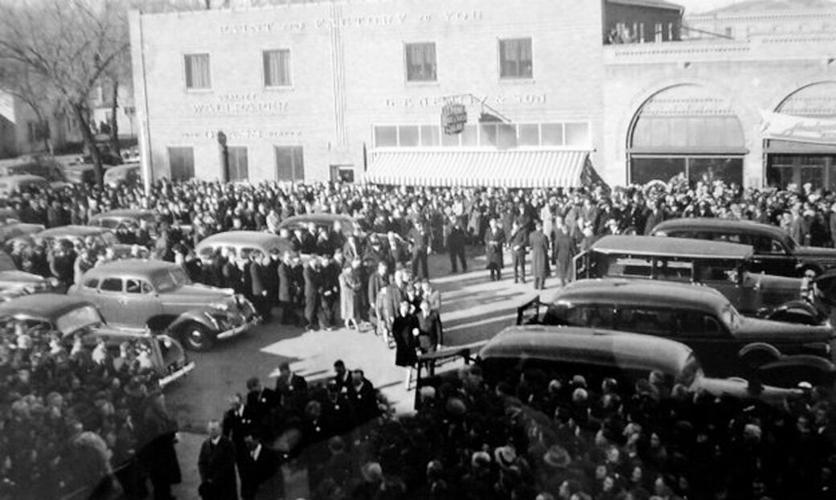
”A mighty blow struck Hutchinson Monday, Nov. 14, 1938, as the word flashed through the community that four of Hutchinson’s finest and most honorable young businessmen had become the fatal victims of carbon monoxide gas in their improvised trailer house deep in the north woods near Big Falls. A fifth was lying in a precarious condition in a hospital at Little Fork, near the Canadian border,” reported the Hutchinson Leader.
Luckily, Julig’s condition improved and he was able to live a full life. For the other four, however, they left behind families, children, and friends who would mourn their loss for years to come. It remains as one of the area’s greatest tragedies to this day.
— Brian Haines is executive director of the McLeod County Historical Society and Museum, 380 School Road N.W., Hutchinson. The museum is open 10 a.m.-4 p.m. Monday through Friday, 1-4 p.m. Saturday an.d by appointment. Admission is free. For more information, call the museum at 320-587-2109