

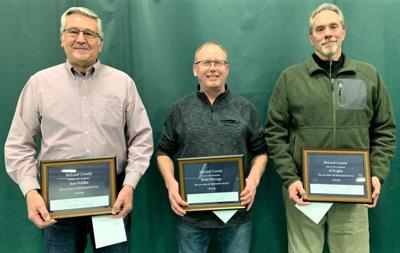
Between improvements to parks, the maintenance of equipment and the clearing of snowy roads, a lot of work has been done between three McLeod County men over the past 40 years.
Parks director Al Koglin, plow driver Ken Polifka and shop foreman Brian Schrupp have been at it since 1979, making them the longest-serving county employees among those recognized at a banquet this past Friday.
"They are both tremendous people," Koglin said of Polifka and Schrupp. "Kenny and Brian are very nice people. I was surprised walking in that night that they were both there. It was kind of fun. They have gone through just as many changes as I have, probably more."
"(Schrupp) is the kind of man that had to be there to keep everything running," Polifka said. "He is an exceptionally good mechanic. Guys would call over the two-way and say, 'My truck is doing this.' ... He'd sit there and be quiet a little while, and then say, 'Try this.' God, he's smart about that stuff."
"I'm the go-to guy I guess," Schrupp said. "It's from working on this equipment for all these years."
Koglin started with the parks director title he has now, but along the way roles have adjusted and he's taken on new responsibilities. As the county merged departments in recent years, he's no longer considered a department head, but he now also works as the county's weed inspector. He grew up in Hutchinson and graduated from Hutchinson High School before heading off to college and ultimately returning. He and his wife, Debbie, have two sons, five grandkids and one more on the way. Koglin originally planned to teach, but switched to parks and recreation in hopes of finding more job opportunities.
Polifka was born and raised north of Glencoe, but eventually he moved into town with his wife, Nancy. At one time, the family had such a long driveway that they would be stuck at home while Polifka was clearing other roads for the county.
Polifka's three brothers still live near their childhood home, and he has children living in Glencoe. It won't be long before he and Nancy are great-grandparents. His work with the county is part time as he works full time at his business, Ken's Excavating, which he started in 1979. Ken's Excavating now has three generations on the clock, as Polifka is joined by his son, Cory, and his grandson, Matthew.
"(The county) needed part-time help," Polifka said. "I said, 'Sure, that'd be fine.' And at the same time ... I started to drive school bus part time. So this year we had a milestone. I had 40 years with the county, 40 years of my own business and 40 years driving part-time school bus."
"Ken is actually my neighbor," Schrupp said. "I get along good with him. He has his own construction company so he helps me out at my place occasionally."
Schrupp started out as a mechanic but was promoted to shop foreman around 1993, he believes. Originally from the Hamburg area, he was used to rural life and took the job in McLeod County after vocational school. He continues to live in the county with his wife, LynnEtte.
"It went by fast," he said. "And 40 years is a long time."
Koglin, Polifka and Schrupp chatted with a reporter this week about their time with the county.
AL KOGLIN, PARKS DIRECTOR
What brought you to work in McLeod County?
"I applied (for jobs) just about all over the United States. When the job at McLeod County opened up, I wasn't going to apply because someone told me that it was already set up for someone else. Hazel Sitz called me into her office because I worked for the city of Hutchinson at that time. She said, 'Al, go down and apply.' So I did, and 40 years later I'm still here. So I owe a lot to Hazel."
How have your job responsibilities changed?
“When I started, the six parks were here but the two campgrounds weren't open yet. They told me my main objective was to get Lake Marion and Piepenburg campground open.”
"It was just a farm when I got here. And then basically we spent five years getting all the development, and we're still doing some development. … More of (the change) is working with groups like fat tire bike groups using a park, the Frisbee golf, they would like to find a home for themselves. We have cross-country skiing. We have snowshoeing and people walking. So there is a lot more public relations. I'm not so much out in the field as I was.”
What are some of the biggest projects you've taken on in the last 40 years?
“There is the development of Piepenburg. That was 154 acres we developed into a campground, a beach area. We developed another trail through one of the other parks, Stahl's Lake Park, someone had donated a lot of money.”
"(And) Taking the plans of Lake Marion Park and making the bathhouses. The park trails were there, but at Piepenburg we didn't have trails. We put them in. ... That's something hopefully I am still around when my grand kids are big enough, and I can take them out there and say, 'I was involved in this park.'”
Did you tackle any projects that may seem like ancient history now?
“We do a lot of work with the (Department of Natural Resources) on public access. I think that's one thing that Sen. John Bernhagen called me up on one day and said, 'Al, there is a grant out there you can apply for and get fishing piers.' He said, 'How many do you think you'd like? I'll send the paperwork.' I said, 'Well, we'd like to get three of them.' And we did. Nobody else applied that year. We got three huge fishing piers. They were made at the Texas prisons and shipped up here, put back together. We had one at Swan Lake, Lake Marion and Piepenburg. … That was probably about '85. … We were in line and when they wore out, DNR put us back on the list and we were able to get more.”
A road on the north side of Campbell Lake shares a name with you. What's the story there?
“When I was in college, dad developed (a housing development) down by the corner there. He had to name the road. Well, he took too long to name it. He was going to name it partly because of Campbell Lake and all this other stuff. He did not want it named Koglin because he did not like to get grief from people. Then one day I went to a city meeting, it was probably '81, '82, maybe a little later than that. I looked at a big city map and there they had a road and it said Koglin Road on it. So that night I drove … out to my folks and I said, 'Dad, I've got something to tell you.' And I had taken a Polaroid picture, and I said, 'Here, look at this.' And he couldn't believe it. … Now it's kind of cool. My dad didn't like it when he first found out … My dad is gone now but I think he liked it at the end. You always want to have something you have your stamp on. Everyone likes that.”
What technology do you use today that would have surprised you 40 years ago?
“Computer, big time. Cell phones, big time. My first cell phone was in a radio in a truck, it was a party line. Then we went to the cell phone that looked like a 2-by-4. And then we got smaller and smaller. Before I had anything, they had a problem where they couldn't find me. So they gave me a pager from the sheriff's office. So when my secretary … would call dispatch, they would page me and I would try to find a phone or get to a phone as soon as I could. If she would page me twice in a row I knew it was important enough to where I needed to get to a phone.”
“I have a system I am getting now for my weed inspector job. If I am out on a road, if I go to a property that has a complaint, I hit a button on the laptop and it will automatically tell me where I'm at and whose property is around that, so I know exactly who owns that property right away. Before I would have to go and sit down, or go to the recorder's office, and look at a map.”
What changes or improvements do you see coming in the next 40 years or sooner?
“It's going to be more setting things up to try and get the millennials out. Frisbee golf, things like that. Some of the metro county parks are getting more usage for people using drones. It hasn't worked its way out here, but it will be. So we may have to designate an area in the parks for that. Usually if there is something in the metro going on it takes a few years for it to get out here. Not as long as it used to.”
Any final word?
"I'd like to thank all the people I've worked with the last 40 years. We've had a few caretakers over the years. Steve Wurscher, who I have worked with forever, he's the park manager. And then Scott Powers, he's a retired teacher from Buffalo Lake-Hector-Stewart, but he's worked for us for over 35 years. Every summer he's worked for me. If it hadn't been for those two and some great support staff over the years, my job would have been a lot harder.”
KEN POLIFKA, PLOW DRIVER
Al Koglin mentioned the first plow truck you drove was quite interesting. Can you tell us about it?
“The big plow at that time was called a Walter. It was a big truck. It had four-wheel drive … they were beasts. They had a great big V plow on them, and a wing. And it took two men to drive that doggone thing. One man to operate the up and down with the V plow and the wing, and one man just to try and keep that damn thing on the road. They were beasts. ... We didn't plow all the time with that Walter. … It was mostly for widening out roads. You didn't go up and down roads if you didn't need to.”
Where do you plow in the county?
“They would send me to any one of the routes. There are six. … They would call me in to plow, let's say Glencoe. So I head into the shop, hop in and off I go. There isn't a route in the county I haven't covered. ... Each time you go out and plow, it's two trips and you go both ways. So if you have a 50-mile route ... that's 200 miles.”
What is most important to look out for when plowing the roads?
“Just the conditions. The road, if it's slippery. Maybe when you see trucks go by it may look like they're going fast, but they're not. It's maybe 20-25 mph. Maybe for the second time around you might go 30 if it's decent. And mailboxes. You have to keep away. You start at 3 or 4 in the morning, so you don't have to worry quite so much about cars and stuff. And especially in the country it isn't quite so bad.”
What have been the biggest changes over the past 40 years?
“The equipment. The trucks were all standard transmissions. Now you get in a truck and its all automatics. … I can sit with my hand on a joystick, basically, and you can operate the whole truck, its functions, the plows. That all can be done with one hand. Up and down with the plow you just push a little button. It's unbelievable. When I first started, there must have been about eight levers sticking out the floor and nothing was marked and it's dark. You just got used to it like anything else.”
What do you most enjoy about living in McLeod County?
“I grew up north of Glencoe. I just like it here. It's nice, small. I don't know what to tell you. We like it here and now our family is here. Our daughter and son live in town just a hop, skip and a jump away from us. Our grandson lives a block away from us. And our granddaughter is right next to my home place. And in a couple of weeks we'll be great-grandparents.”
BRIAN SCHRUPP, SHOP FOREMAN
What have been the most surprising changes over the past 40 years?
“Now instead of being mechanical repair, it's mostly all electronics. The controls on the hydraulics, the GPS units, everything is electronic over hydraulics instead of mechanical levers and cables.”
“It's probably a good change. Everything works a little better. But it is harder to diagnose. You just have to learn by doing it.”
Is there any major hurdle or challenge that sticks out to you from your time with the county?
“Any major snowstorm can be a problem. Trucks get stuck and run off the roads. The worst one was that Halloween storm. I think that was '93. There were a few plows stuck. That was a winter that started early and went late.”
Do you ever do any driving for the county?
"Sometimes I get in the plow truck and drive, but I try to avoid it. Those guys are better at it than me.”
What issues tend to pop up most often?
“Right now it seems to be a lot of the new ignitions in the last five years or so. There are a lot more sensors. There always seems to be a sensor going bad somewhere in the system. It's a lot of diagnosing with the laptops and plugging into the truck and seeing what route to take."
What's kept you at it for 40 years?
“I ask myself that every day. It's a close drive for work instead of going down to the metro. And it's the people I work with.”
How much longer do you think you'll stay on the job?
"I get asked that question a lot lately. I don't know. I've got a couple of years yet maybe.”
"I have a good replacement already. (Eric Gutknecht) started a couple of years ago and he's fitting in good."

