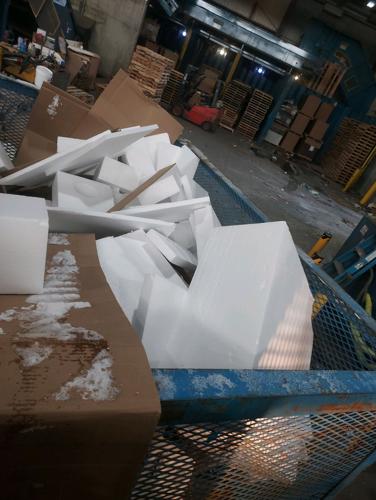
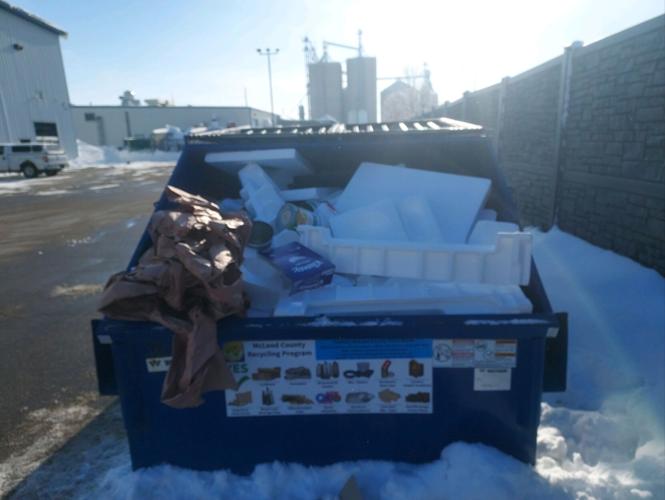
Photos taken this past week show bins outside the McLeod County Household Hazardous Waste facility in Hutchinson stuffed full of Styrofoam waiting to be recycled. But there's one problem: It can't be.
The same goes for wood, food products, wrapping paper, Christmas lights and many other products seen over the holiday season, but frequently beforehand as well. While the drive-up bins outside the facility are meant as a convenience to the public as a place to leave recyclable materials for free, they can't take everything. That's why McLeod County Environmental Services Director Marc Telecky asks residents to read the signs posted at the bins, and to step inside if they have any questions. Because even though materials such as Styrofoam can't be sorted with the rest of the recycling, there are other processes for it if it's dropped off at the proper place inside.
"This isn't a moneymaking venture," Telecky said. "This is a service to the public, and it's about landfill diversion."
Every pound recycled, in other words, is a pound not sent to the landfill. And the county can do that so long as it can manage to break even on recycling material it processes, and hands off to larger entities, or sells. If the general material collected isn't pure enough, the county ultimately pays for that, and that cuts into the bottom line.
"That's the nutshell of recycling at a local level: Whatever goes into our stream we have to make sure our refuse percentage is 5% or less," Telecky said. "If we can do that, then thins are going extremely well."
Many other products that don't belong in the bins can be collected and sold inside the facility, and there are employees inside to help, but, HHW doesn't have the extra funds to simply have an employee sit outside and monitor the situation.
As far as Telecky knows, McLeod County is the only county in Minnesota not to charge residents a solid waste tax. It's able to do that by breaking even, and cuts to its revenue by improper sorting threatens that stability.
"It's a fine line between offering a service to the community, but trying to get people to be responsible," Telecky said. "There are people abusing it. That has to stop. We can't have the 10 percent affecting the majority."
He has potential solutions in mind — education, for instance. But he's also noticed the improper sorting problem dwindles when the gates are closed to traffic, but the bins remain open to walk up drop offs. There have been issues at a Glencoe drop site as well, and at one between Winsted and Lester Prairie. Items that cannot be recycled, such as televisions, have been found left at the sites.
"What I'm asking is, hopefully this spring, we will work to really fence these in, secure these better," Telecky said, "so people can't drive up next to hem and drop this stuff off."