
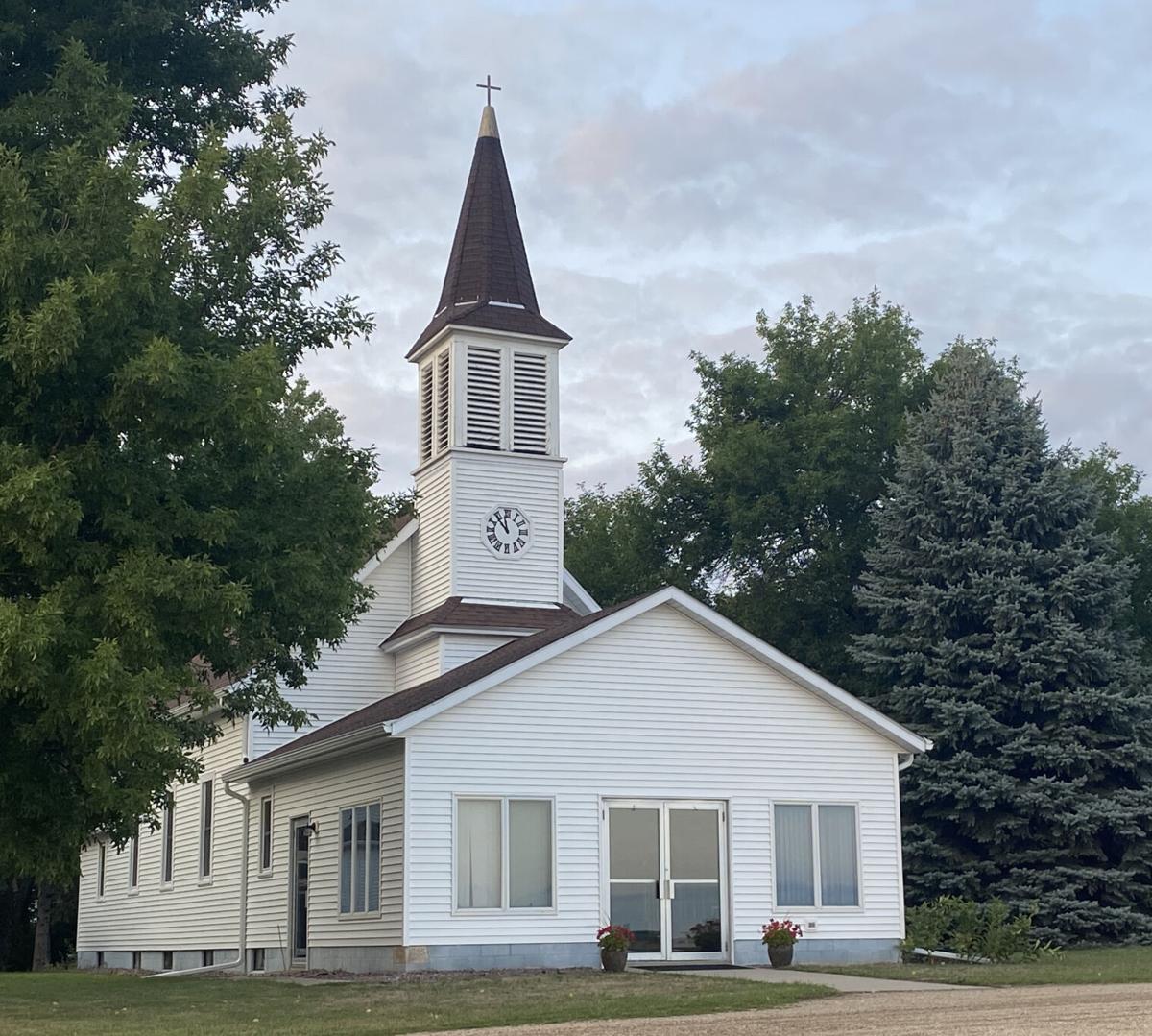


It was about this time last year that Zion Evangelical Lutheran Church in rural Hutchinson would have been getting ready to celebrate its 125th anniversary. However, in July, the church council pulled the plug on the festivities due to the COVID-19 pandemic.
Fortunately, things are looking better this year, so plans are moving forward for the church’s 125th celebration during its 126th year. Plans call for a catered dinner at 11:30 a.m. followed by a worship service at 2 p.m. The offering taken during the worship service will go to the Immanuel Lutheran School. All events are taking place Saturday, Sept. 19, at the church, 16494 Vale Ave., Hutchinson.
“It’s better late than never,” said Allan Duesterhoeft, church treasurer.
Conducting the worship service will be the Rev. Daniel Reich, who formerly served the dual parish of Immanuel Lutheran and Zion Lutheran. Joining him are sons Jacob, who is youth and outreach pastor at St. John’s Lutheran Church and school superintendent at St. John’s Lutheran School, both in Bay City, Michigan, and Nathan, who is principal and seventh- and eighth-grade teacher at St. Paul’s Lutheran Church in Tomah, Wisconsin.
While the church has expanded in physical size over the years, the reverse has happened to the congregation. Zion once had more than 100 members but today the count is 47.
“The average age of our congregation is 60,” said Dean Duesterhoeft, church secretary. “We’ve never been a really big church.”
Currently, the Rev. Eugene DeVries serves dual congregations of Immanuel Lutheran and Zion Lutheran.
“We base our beliefs and always will on the Bible,” said Allan Duesterhoeft.
Zion Lutheran is a member of the Wisconsin Evangelical Lutheran Synod, or “WELS” or “Wisconsin Synod” for short. It is an American Confessional Lutheran denomination of Christianity. Characterized as theologically conservative, it was founded in 1850 in Milwaukee, Wisconsin.
IN THE BEGINNING
The genesis of Zion Lutheran can be traced to Sept. 29, 1895, when 13 German men and their families gathered to form a church. The charter members were Carl Ewald, Berthold Mallow, M. Fred Marx, Fritz Plath, Charles Plath, John Plath, John Polchow, Eduard Rettmann, August Scmidt, Eduard Schmidt, Johann Schmidt, Joachim Vorbeck and Henry Woehlke.
Its name — Zion — came from its location — on a rolling hill. According to the church’s Golden Jubilee booklet, the name Zion was suggested in the lyrics of Wisconsin Synod hymns, “Zion stands by hills surrounded” and “Standing high on Zion’s wall,” plus the verse “The Lord of hosts shall reign in Mount Zion” from Isaiah 24, 23b.
Initially services were conducted in German at the District 75 school, on the south end of Otter Lake.
With assistance of the Rev. F. Koehler, resident pastor at Friedens Lutheran Church in Hutchinson (now Peace Lutheran), the charter members set about to build a church. The cornerstone was laid Oct. 20. The 24-by-36 church building was to be erected on a rolling hill 5 miles southwest of town. The land was donated by Carl Froemming and Edward Schmidt. The cost of the building: $1,000 and many man hours.
During the first eight years of the church, it was served by pastors of Friedens Lutheran. This changed in 1903 when a parsonage was built and the church was able to call its own pastor. In 1914, the church added a 28-by-20 school building to the property. It was dedicated on Oct. 31, 1915, with classes taught in German. Since the church had no basement, the school building was used in a variety of ways including as a meeting place for Bible class, choir practice and congregational meetings. It also was used as a kitchen and dining room for mission festivals and other special occasions. The school continued until 1935 when it was closed and the children then attended public school.
During World War II, 13 men from Zion served in the armed forces: Pfc. Willy Homburg, Cpl. Edwin Klawitter, T-4 Louis Reckow, Staff Sgt. John Duesterhoeft, Staff Sgt. Dan Duesterhoeft, Cpl. Ernst Duesterhoeft, Cpl. Everett Hagen, Pvt. George Plath, Pfc. Arnold Muetzel, Pvt. Albin Plath, S2/C G.M. John Peterson, Pvt. Milan Rettman and Pvt. Arnold Plath. Only one made the supreme sacrifice — Pfc. Willy Homburg was killed in action Dec. 20, 1944, in Belgium. He was 36 years old.
CHANGES AFTER WWII
It’s interesting to note that the church once faced west but in 1948 — after the end of WWII and building supplies were once again available — the church was raised and turned a quarter turn to face south and placed on a full basement. Bathrooms and a kitchen were installed and the four corners were extended, providing two stairways, a mother’s room and a pastor’s study. The cost of the renovation project: $5,021.05.
Zion had its own resident pastor until 1957. The Rev. Edward Kolander was the last one to exclusively serve the church. After that the resident pastor at Grace Lutheran Church served the congregation followed by the resident pastor of Immanuel Lutheran Church. The relationship was formalized on May 7, 1979, when it was decided for Zion to merge with Immanuel and form a dual parish.
Expansion of the church had been a much-talked-about topic, but it finally moved ahead in July 1984 when it was agreed to enlarging the entry at the front of the church. The 18-by-24 addition provided a place for members to visit before and after services. The new building also included enlarging the basement, new bathrooms and storage space, plus improvements to the kitchen and a new furnace. The cost: $35,955.
In time for the church’s centennial celebration in 1995, it was freshened up with new paint, new vinyl flooring and Venetian blinds.
The original 13 charter members would be proud to know their faith has stood the test of time. While many things have changed through the years, Zion Evangelical Lutheran Church has stood for 125 years built on the foundation of the Bible.


