

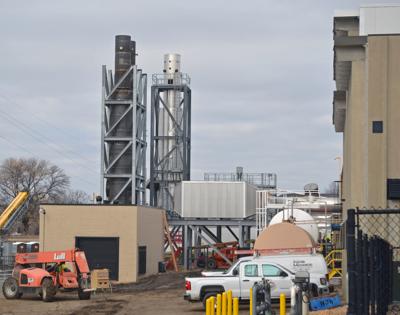
If you’ve driven over the Crow River in downtown Hutchinson recently, you may have noticed the construction of two new towering, cylindrical exhaust stacks at the power plant.
Meanwhile, piping and electrical work is ongoing inside the building for auxiliary equipment on the facility’s generators. While the work is new, it’s part of an ongoing project residents may have noticed last summer when crews installed two new quick-start, 9.3 megawatt generators. The $16.6 million Hutchinson Utilities Commission project replaces three generators that are up to 50 years old.
Hutchinson Utilities general manager Jeremy Carter said the two new stacks will be plated with shiny chrome, similar to the stack that was there before, when the project wraps up.
“We are hoping the whole project is done with the engines ready to go by the end of April,” Carter said.
A month of testing will follow, allowing time to run the generators at various loads and to check emissions.
The Minnesota Pollution Control Agency approved permits for the new units, though a public comment window is open until April 22.
“If there is no public comment regarding the permits for these new generators, then the comment period will close, and we will be issued final permits,” Carter said.
The goal
The plant took out three units between 2008 and 2010 because they were no longer meeting emission standards. The first of three new, more efficient engines was installed in 2013. The final two units are now being installed.
“The overall goal is to make sure we have a diversified portfolio,” Carter said. “The nice thing about these units is they are called quick-start units. You can turn these things on and in five minutes they are up to load.”
As a result, the units can be used actively as needed. Older equipment was not able to safely switch off and on to meet market prices or local load demands. Summer is considered a high load time, as many residents use more power for air conditioning.
The more efficient units will run and provide power for local customers when doing so would provide a better price than the market. When it is beneficial to run the generators and sell on the market to offset costs for local customers, they will function in that capacity.
“It’s kind of a balancing act, playing the markets in real time,” Carter said.

