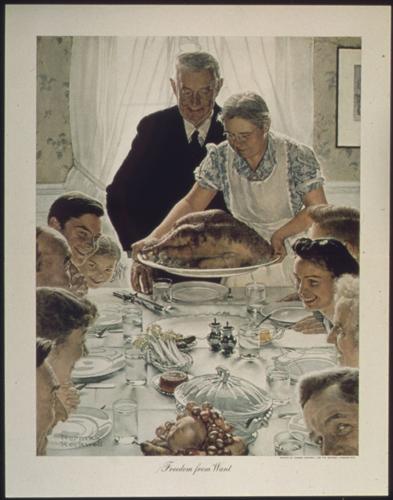
The painting is titled “Freedom From Want,” a Norman Rockwell masterpiece, that depicts a family gathered around a table in anticipation of a delicious Thanksgiving feast. In the picture, a man who is assumed to be the “Grandpa” stands at the head of the table. A large carving knife rests alongside his plate as he eagerly watches his wife present a turkey set on a silver platter and baked to perfection. In a moment, he will begin carving off slivers of tender, steaming turkey meat that will be served to each hungry family member. The painting itself is splendid, a classic depiction of what we Americans describe as the perfect holiday setting. Beneath the layers of oil paint, and beyond the canvas, however, the painting depicts something far deeper than a holiday feast.
Rockwell painted his classic in 1943, a time when the United States was engulfed in a second global conflict. U.S. forces had been fighting against the Axis powers since the bombing of Pearl Harbor Dec. 7, 1941. The first ration cards were sent out in the spring of the following year, and the nation had already begun ramping up production of war materials to send overseas. By Thanksgiving of 1943 it was clear to most that the United States would need to bet all of its chips in order to achieve victory. People were scared, people were angry, but most of all, people needed a way to escape the rationing, travel restrictions, and life altered plans — they needed “Freedom From Want.”
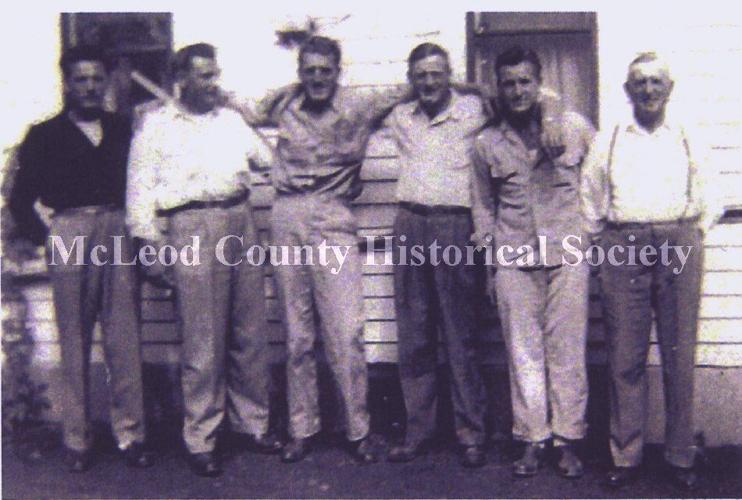
In McLeod County, in 1943, families gathered around the table for a Thanksgiving feast just as they always had. For many families, however, there were a few empty place settings as sons and fathers were absent — rather than gathering with family they were gathered with comrades in military mess halls. One such family was the Odegaards — five of the Odegaard boys were marched off to war, one by one. The first to go, and the last to return home was Leon.
Leon had a draft number so high that he didn’t have the chance to enlist. The 27 year old was called to service in February of 1942. With very little training, he was sent to Angel Island, San Francisco, and given a flamethrower. By June he was sent to Fiji to fight in the Pacific theater. He wouldn’t see home until December of 1945.
As was apt to happen to soldiers overseas, Odegaard was homesick during Thanksgiving 1943. Dreaming of a meal and of family, Odegaard needed a little freedom from want, so he wrote home.
Dearest Mother, Dad, and Brothers. I hope this finds you all well at home. I am feeling fine. I haven’t had any mail for a week, but we will soon have some again. I had a letter from Edith yesterday. You really must have some snow by the way she wrote. Is it as bad as the snow storm we had four years ago? It really came early. I suppose it is there to stay until spring. I wish I was there peddling in it too. Yesterday was Thanksgiving. We sure had a good dinner. I went to church in the morning, so you can see I was a good boy. I suppose you had a big dinner. Who did you have for dinner? I had another letter from Missalke (?). He said he was going home on a furlough for Christmas. He lives about 200 miles from home. I haven’t gotten my glasses yet. Did the last money order come home yet? So you dreamed you met me in Hutchinson. Mother, I have dreamed a lot of times about you, but they never have come true. How are the chickens doing? How are the cows doing? How does papa’s back feel now? ...
As a flamethrower, Odegaard saw a lot of frontline action. “I saw a lot of stuff,” he said. “I always figured my day was next. They would fall alongside of you, and you just figured you were next.”
He fought in several engagements and was on the frontline during the battle for Okinawa. “The Japanese were all over, day and night”, he said. “They tried to get you in the legs so you couldn’t walk. I was shot twice in Okinawa.”
Okinawa was the last major engagement of WWII. The death toll was so high that it ushered in the decision of the United States to drop two atomic bombs on Japan. In August 1945, Japan officially surrendered. Leon Odegaard, as well as his four brothers, were all now safe at home.
In 1945, two years after Rockwell painted his famous masterpiece, the people of the United States of America could finally gather around their Thanksgiving tables and enjoy a meal that was free from the want that was so prevalent in the years prior.