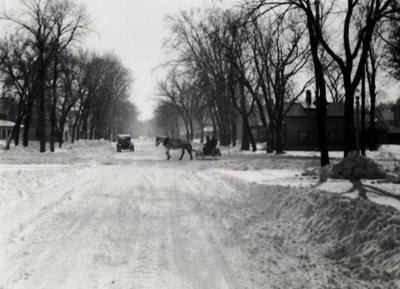
It has been a fine autumn. There’s been a few cold days, of course, but enough pleasant weather has been sprinkled in to safely say we’re having a somewhat mild fall. It’s that type of fall weather that lulls us into a sense of security and makes us forget that winter could land on our doorstep any time. So was the case during November of 1940 when the famed Armistice Day Blizzard dropped a veritable “bomb” of winter on Minnesota.
It was Nov. 11, 1940. Today we call it Veterans Day, but in 1940 it was a day meant to remember the Armistice that ended World War I. Like the autumn of 2023, the weather leading to Nov. 11 had been mostly mild. No snow had yet fallen and people milled around in shirtsleeves. While people were still hanging clothes on the line and collecting late harvests from vegetable gardens, Mother Nature was cooking up one heck of a storm.
Forecasts on Nov. 10 were mild. In some parts of the state it was drizzly and “muggy” feeling. The weather was about to change, however, as the forecast for the 11th called for a drop in temperature with the possibility of light snow.
For many, especially the duck hunters, the change in weather was a welcome sight. One such young man, Harold Phillips, took advantage of the change and headed out to Eagle Lake, 10 miles southwest of Hutchinson, where the ducks were sure to be on the move. The ducks did move that morning. Some who were witness to the event would recall how the ducks flew in droves of thousands as they attempted to stay ahead of the storm. Eventually the cold and snow caught up. What started as light snowfall turned into a blizzard of ice, snow, and sleet that was driven by wind gusts of more than 40 mph. In addition, the mercury plunged. Like many others, Phillips attempted to leave his hunting spot, yet found the roads to be clogged with heavy snowdrifts.
“It was cold I tell you. Some snow drifts were as high as the telephone poles,” Phillips would later recall.
Phillips was forced to leave his car in a snow drift and walk. Some time later, a car came along the road carrying three other hunters. They stopped and Phillips climbed inside. They found themselves stuck again near Heatwole. Luckily, they were near a residence and were able to find shelter inside. It was there that they spent the night. The following morning, they trudged, in hip boots, back to Hutchinson.
Another local man, Ralph Bergstrom, had a similar experience. Ralph, along with his wife and 2-year-old son, were on their way to Hutchinson when the storm hit. They were on their way home from Minneapolis and were nearly to Glencoe. About three miles out of Glencoe they hit a large snow drift and it stalled their ‘36 Chevy. Ralph spied a farmhouse in the distance, and together the little family trudged through the snow to the house for safety. The Bergstroms were the first people to arrive at the house, but were soon joined by other stranded motorists. They were eventually joined by three students from the University of Minnesota who were in the area hunting ducks. For three days the party was stuck in the farmhouse while they waited for the roads to be cleared.
At the time, the storm was coined the “Blizzard of the Century,” later to be replaced by the “Super Bowl Blizzard of 1976.” The key difference, however, was that in 1940 weather-predicting technology was far inferior to what it was in 1976 or in 2023. People had little indication of what the weather would do and some perished because of it. In total, 150 people died in the Armistice storm, 49 of them from Minnesota, and most were duck hunters. Today, the Armistice Day Blizzard is a key reminder that you just never know what Mother Nature has in store when she decides it’s time for winter to come calling.
— Brian Haines is executive director of the McLeod County Historical Society and Museum, 380 School Road N.W., Hutchinson. Do you have a historical anecdote to share? Haines can be reached at 320-587-2109, or by email at director@mcleodhistory.org.