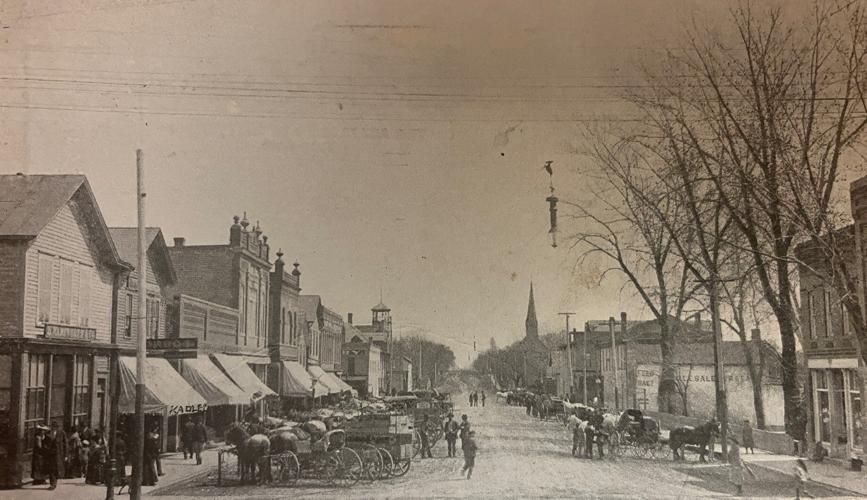
History certainly is a wonderful thing. The stories, the people, and the places all return to life for a brief moment when we take a little time to explore the past — especially when it took place right in our backyards. Here in McLeod County, we are lucky to have a well-documented past to learn from and to build on. With that in mind, it always amazes me how many things we can discover in the present to add to the illustrious story that is our history. A perfect example of this is the Glencoe Preservation Society where a group of history enthusiasts have been combing through collected history to better understand, better interpret, and add to the story of how Glencoe came to be. I can’t say, for sure, when their project will be finished, but I can offer a little insight into what the early years were like for McLeod County’s first community.
Glencoe was first laid out and settled in 1855, but the story of how it came to be stretches back even farther. The future site of the town was once a regular stopping place for a Dakota leader, John Other Day, and his band. They were apt to camp along the banks of Buffalo Creek. It was there, in Other Day’s camp, where Martin McLeod likely came across the site for the first time.
The demographic landscape of Minnesota pre-1855 was largely native with small pockets of Euro-American and mixed blood people. That demographic was fated to change in 1851, however, as Dakota leaders sold the bulk of their land to the United States, and in a matter of a few short years, the first flood of Euro-American immigrants began coming to central Minnesota. In the case of McLeod County, it was Martin McLeod leading a group of settlers and speculators to the former camp site of John Other Day where they would lay the foundation of Glencoe.
It didn’t take long for people to settle in Glencoe and the surrounding area. Within a year, the community was joined by Hutchinson, Koniska, Grimshaw Settlement, Bear Creek, Lester Prairie and Cedar City. By the end of 1857, the majority of McLeod County, albeit unsettled and mostly devoid of settlers, was under deed and title.
The initial surge and spread of settlers in Glencoe and the rest of McLeod County in 1856-57 was short-lived. A severe winter in 1856-57 brought things to a rapid halt — for many settlers this was their first taste of a Minnesota winter. Snow accumulated to three feet and the high drifts made travel nearly impossible. To make matters worse, spring came late, and farmers suffered. In addition to the weather, there was the case of overexpansion and overspeculation. Speculators acquired large swaths of land intending to reap massive profits, but unfortunately, an economic depression, known as the Panic of 1857, set banks to fail and speculators sitting with land that they could not sell. For those living in the area, money was non-existent, and currency was based on bartering furs and any food source that could be processed, gathered, or hunted, and any service that could be offered. Later in 1857, a scourge of grasshoppers devoured vegetation and caused a food shortage. Lastly, a rumor of a large Indian attack planned on Glencoe was spreading around the region like wildfire. It turned out not to be true, but it didn’t help speed up the flow of new immigrants to the area.
The hard times of early Glencoe citizens began in 1857 and didn’t really end until the Civil War was concluded. Young men in the area left homes and families to fight the Confederates in the south. Then, in 1862, the Dakota War/Sioux Uprising caused many settlers to flee the area and never return. The Glencoe residents that stayed behind banded together, created a home guard, and built a fort named “Fort Skedaddle” — aptly named as it was a stopping place for settlers looking to “skedaddle” out of McLeod County.
As evident by over 150 years of growth, the initial hardship years of Glencoe and McLeod County eventually ended and growth resumed. More hardships such as the Grasshopper Scourge of 1873-1876, the Great Depression, and two World Wars would take their toll on the community, but as every good Minnesotan knows, you must take the good with the bad.
The history of Glencoe and McLeod County is filled with interesting and exciting events. Unfortunately, a small newspaper column simply doesn’t have the capacity to tell it all at once. With that in mind, I’m excited, as should be everyone, to see and read the new and revamped History of Glencoe once it has been finished.
— Brian Haines is the executive director of the McLeod County History Center, 380 School Road N.W., Hutchinson. Hours are 10 a.m.-4 p.m. Monday through Friday, noon to 4 p.m. Saturday and by appointment. For more information, call 320-587-2109.