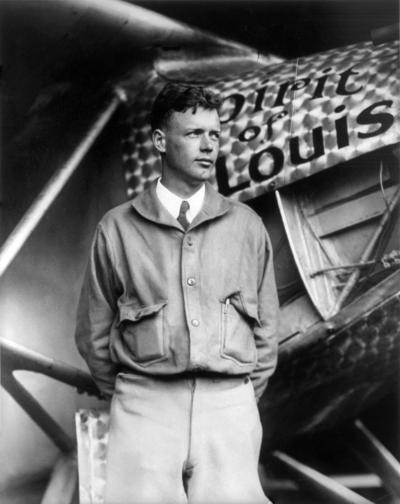
We’ve all heard of the legendary aviator Charles Lindbergh. Alone in his aircraft, The Spirit of St. Louis, the famed pilot became the first person to fly across the Atlantic Ocean alone (previous attempts by others were successful, yet none of them were non-stop solo flights). Lindbergh, who was raised in Minnesota, rolled down a New York runway on May 27, 1927, and successfully landed in the record books in Paris, France, 33 hours and 30 minutes later.
Born in Detroit, Michigan, Lindbergh came into the world just one year before the Wright brothers made their historic first flight at Kitty Hawk, North Carolina. For much of his youth, the young Lindbergh was exposed to the grips of aviation fever — the whole world was captivated by the thought of human flight. As a result, he became interested in not just air travel, but the mechanics of motorized transportation. After dropping out of college in 1922, Lindbergh enrolled in aviation school in Nebraska where he earned his pilot credentials.
For much of his early career, Lindbergh worked as a “barnstormer,” a pilot who traveled from town to town, performing stunts, and offering plane rides to anyone willing to pay for one. In his “Jenny,” a Curtis JN-4 plane built for military service in World War I, he traveled under the name “Daredevil Lindbergh.”
In 1923 Lindbergh planned a barnstorming tour across south-central Minnesota. His plan was to join his father, a Minnesota Congressman, on a special election campaign as a United States senator. He began his tour in Savage, then proceeded to Marshall, Redwood Falls, Olivia, Buffalo Lake, and finally Glencoe.
The famous pilot entered Glencoe and attracted attention by hovering over the city. On the farm field of G.E. Miley, southwest of town, Lindbergh brought the plane to a halt. The plane was to take off again and hit the air with another set of feats to impress the watching crowd below. As the plane sped down the field, Lindbergh began urging the plane’s nose upward, so the wings could catch air and climb into the sky.
Unfortunately, a wheel on the plane dropped into a ditch and the nose of the plane plowed into the ground with great force — picking and spraying dirt and mud as it plowed forward. The plane then upended. The steering cables snapped, the propeller and landing gear broke, and the tail section snapped off. In addition, one of the plane’s wings was sheared off the craft and broke.
Lindbergh was, of course, shaken. Luckily he suffered no severe damage other than a big scare and jolt to the heart. The pilot then left the scene immediately and traveled to Litchfield where he was scheduled to give a speech in support of his father’s senatorial candidacy. He later returned to Glencoe to repair his plane.
Heston Benson, a Glencoe citizen, was acquainted with Lindbergh and offered his garage to Lindbergh as a workplace to repair the plane. For a week, Benson and Lindbergh toiled in the garage, repairing the plane, and making it airworthy once again. When the job was complete, Lindbergh offered flying lessons to Benson who later became a “wing-walker,” a person who would walk out onto the wing of a flying plane.
Lindbergh would go on to gain more fame, especially for his transatlantic flight. His famous plane, the Spirit of St. Louis, now resides at the Smithsonian National Air and Space Museum in Washington, D.C. His story of a failed takeoff in Glencoe, Minnesota, however, resides in the memories, and texts of McLeod County history.
— Brian Haines is executive director of the McLeod County Historical Society and Museum, 380 School Road N.W., Hutchinson. Do you have a historical anecdote to share? Haines can be reached at 320-587-2109, or by email at director@mcleodhistory.org.