



It's been said when life serves you lemons, make lemonade. Brian Haines, executive director of the McLeod County Historical Society and Museum, has done just that.
When cost overages occurred in building the museum's new wing, Haines came up with the idea of bridging the gap with a unique fundraiser. His idea: Create a legacy wall with an agricultural theme. The idea is to sell the 900-plus cinderblocks to commemorate McLeod County farmers and their farms. The cost: $100 each. Buyers will have the option of listing the farm and when it was established or the name of a farmer with birth date (and death date, if applicable). Color is optional, too. John Deere fans can have a green block with yellow lettering. Allis-Chalmers enthusiasts can select orange, while Farmall, White and Ford users can choose red, white or blue, respectively.
“It was a great idea, but we needed something to tie it together and give it more pizzazz,” Haines said, “so we commissioned Dave Wegscheid to paint an 8 foot by 12 foot mural of Les Kouba's (painting) 'Corn Pickin' in the 1930's.' It's a farmer hand-picking corn, Kouba's 13 pheasants are scurrying out of the corn. A lot of his paintings are based on memories. The farming memories (in this painting) would have been made in McLeod County. It has a homey feeling to it.”
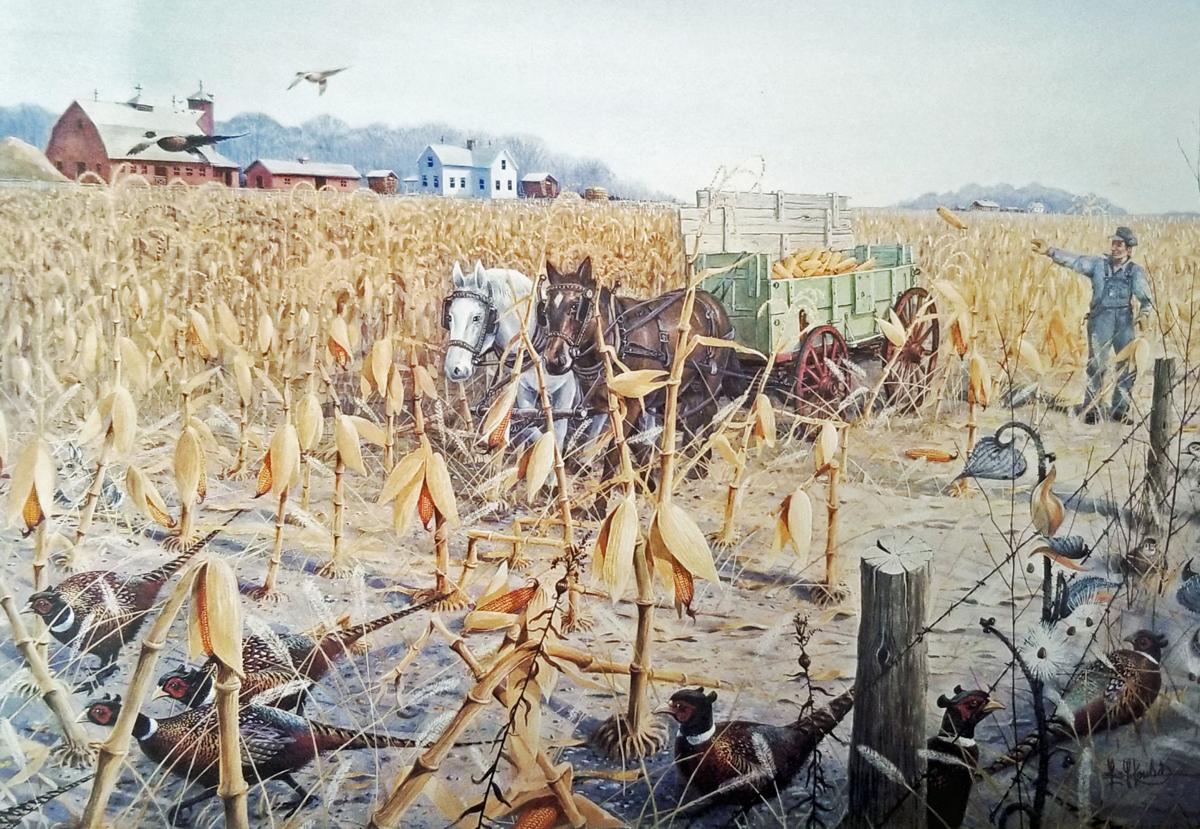
Right — This is the Kouba image Wescheid is recreating into a mural.
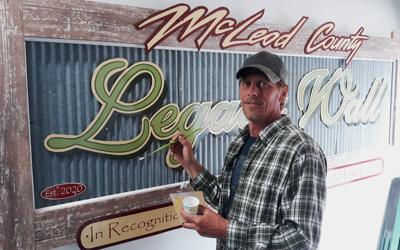
To add to the presentation, Wegscheid is lettering the sign: McLeod County Legacy Wall in recognition of the historic significance of farming and agriculture in McLeod County
While it was a great fundraising idea, Haines admitted the museum couldn't do this project for free.
“We had to go out and before selling (cinder) blocks, we had to raise funds for the mural,” he said. “I could bring farmers in and we could tell them about the project, but they would say, 'It sounds like a great idea, let me know when you have it going.'”
To have something to show potential donors, Haines approached the Burich Foundation at Citizens Bank in Hutchinson. He shared the mural idea with Connie Lambert, who said it sounded like something they would be interested in and encouraged him to submit an application.
The Burich Foundation provided a matching grant of $4,000, which required Haines to raise the other $4,000.
“I put feelers out in the magazine and within two weeks we had all the money,” he said. “We have sold a half-a-dozen blocks already. The hope is once we have the mural up with several blocks in place, people will see that its established and want to participate.”
Originally, Haines gave Wegscheid a short deadline of three weeks to complete the project. The goal was to have it finished in time for the grand opening, which was scheduled to coincide with the museum co-hosting with Thrivent the program “Keeping the Farm in the Family.”
“We thought it was a great time to unveil it,” Haines said. “If it wasn't finished, we'd post pictures. We had to cancel that.”
FROM THE ARTIST
It was Haines who selected Kouba's painting of “Corn Pickin' in the 1930's” for the mural project.
“It's what the legacy wall meant — farms in McLeod County,” Wegscheid said. “Les Kouba. It was perfect. He told me flat out this is what he would like.”
Working from his home studio in Stewart, Wegscheid said the deadline for the the mural went from “three weeks to who knows.”
“This is working out well doing it this way,” he said. “When its done, I'll have time to go back in and keep working it and working it. The more time I'll have, the more pop it will have.”
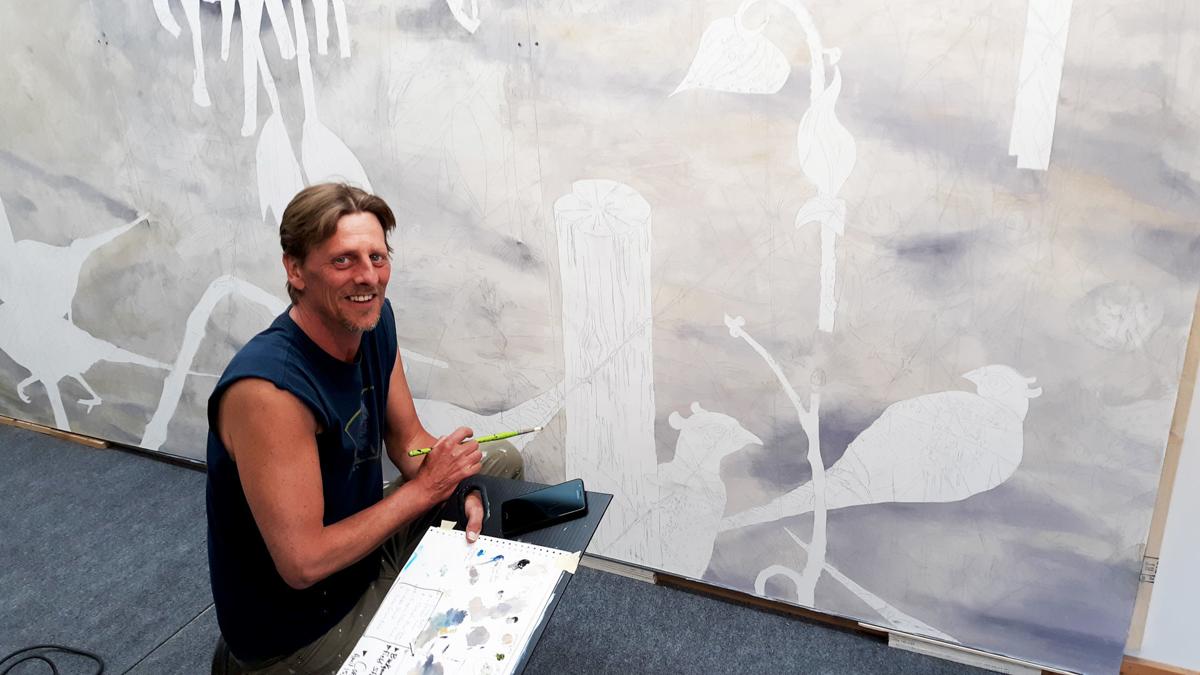
Artist David Wegscheid is working at his home studio in Stewart. He is painting in the background for the mural of Les Kouba's painting, "Corn Pickin' in the 1930's." It will be the centerpiece of the museum's new Legacy Wall, which honors McLeod County farmers and agriculture.
While the museum's Kouba mural at 8 foot by 12 foot is smaller than the 20 foot by 17 foot "By the Country Store" Kouba mural Wegscheid painted in 2017 for the Ace Hardware building in downtown Hutchinson, the artist said it's actually more challenging.
“Its smaller and so much more detail than the first one," he said.
Though Wegscheid and Kouba never met, the two Hutchinson natives would have had plenty to talk about if they did. Before he became famous for wildlife painting, Kouba was a sign painter. He traveled from town to town painting Coca-Cola signs on the sides of buildings and trucks. Like Kouba, Wegscheid is a sign painter and has done his fair share of Coca-Cola signs.
SCHEDULING A GRAND OPENING
Due to the COVID-19 pandemic, everything is up in the air for the McLeod County Historical Society and Museum.
"It's so unknown,” Haines said. “We canceled all our March and April events. We might be able to open up May 4, but will there be stipulations on how many people? We were in the midst of setting up the artifacts — from the donor and our own artifacts. That's been put on hold. We thought we'd have the whole month of April to do that. We'd have to have a few weeks of preparation and planning before we can give the go-ahead for the grand opening. We'll know more in the beginning of May. I'm hoping things will get back to normal. Sometime this summer we can have our grand opening and unveil the mural and all that good stuff.”
During Gov. Tim Walz' stay-at-home order, Haines has been working from Paynesville.
“My wife is essential,” he said. “She's an insurance agent. I'm not. My first week at home with our 4-year-old, I had to tell my son, 'I'm busy. I can't change the channel.' He brought me his extra walkie-talkie. If he needed something, he'd get on the walkie-talkie. 'Dad I need you to change the channel.'"
Haines said his first couple of weeks were productive. He caught up on stuff including working on a book of his columns, the historical society's magazine and correspondence.
"After a couple of weeks you saw the effects of the work at home," he said. "I had no events to plan. I don't have any fundraisers I can work on because we don't know what's going to happen. I'm still finding things to do, but I'm having to look hard. It is what it is right now — a different situation, a different time.”
Although the museum is closed, volunteers are still taking research requests and people are renewing their memberships and the magazine will come out.
"We're not completely dormant, but we're operating at a bare bones minimum," Haines said. "There's not much to report on. We're still here and we're doing what we can."

