
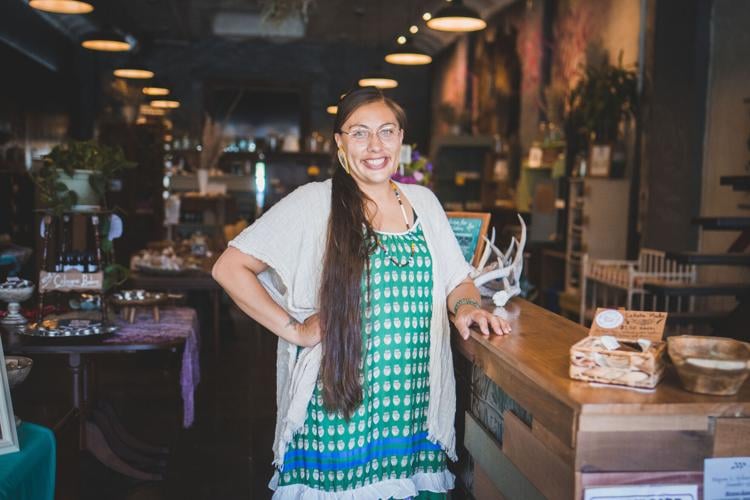


Whether you’re into herbal medicines, read “The Seed Keeper” by Diane Wilson, or just curious to know what it’s all about, don’t miss Hutchinson’s One Book, One Community keynote speaker Megan Schnitker 2 p.m. Saturday at the McLeod County History Museum in Hutchinson.
The title of Schnitker’s presentation is “Bringing Nature Back to People.” As an indigenous traditional herbalist and owner of Lakota Made, she’s built a business that sells plant-based medicinals and personal care products.
“It’s about reconnecting people to nature,” she said.
When the OBOC committee found out Diane Wilson (author of ‘The Seed Keeper’) was not available to speak, the committee set out to find other speaker options.
“While bringing in an author is a first consideration, we’ve had a number of other very successful One Book, One Community programs that featured other guest speakers,” said Katy Hiltner, Hutchinson Public Library’s head librarian. “We were thrilled when Sherry Nagy, a committee member, suggested Megan Schnitker. ... Megan’s presentation ‘Bringing Nature Back to People’ will make real-life connections and complement the book “The Seed Keeper.”
MEET MEGAN SCHNITKER
Schnitker’s presentation will build on the theme of Wilson’s book, which is reconnecting people with what grows outside.
“It’s close to the work I do — not just herbal medicine but teaching people about what’s outside — how we used plant medicines to save our culture by teaching other people about it.”
Schnitker grew up in South Dakota where the nearest neighbor was miles away and the nearest town, hours away.
“I grew up on my grandparents farm — me, my cousins and siblings,” she said. “If we didn’t want to help do chores, farm stuff, then we were outside — from sunrise to sunset, sometimes later. If we came to the house, we’d get put to work. We were running around the farm — feral children with no shoes. My uncle started teaching us about different plants as snacks and plants that could help heal or stop the itch — all that kinds of stuff. That’s where our plant knowledge started.”
She credits her great-grandmother who started teaching Schnitker when she was 8 years old about the traditional uses of plants.
“I knew 10 to 20 plants by the time I met her,” Schnitker said. “She taught me how we used to use things, the traditional uses, spiritual uses. After she passed, I learned from community elders. I attended Sinte Gleska University (a public tribal land-grant university in Mission, South Dakota, on the Rosebud Indian Reservation).”
Plant information was readily available through the Lakota Studies Department. Schnitker had a group of 10 elders and as long as she brought coffee and cigarettes, they would share their stories.
“With coffee and cigarettes they were good to go for hours,” she said. “Every time I go back, they ask did you bring you any coffee?”
Schnitker learned different plant formulations, which she made up into tinctures and teas for friends and family. Occasionally, she would make a healing salve for tattoo shops.
“When I moved to Minnesota and got remarried, my husband said, ‘Why don’t you sell it? I thought, anyone can do this. It’s pretty easy,” she said. “It took almost two years of him trying to convince me. I had a pretty large Facebook following on my personal page, so I made a small salve order and sold it right away. People wanted more. ‘Maybe he was right.’ It kept going from there.”
Schnitker started selling at craft fairs, festivals and wherever she could rent a booth. Then the COVID-19 pandemic hit and all in-person events were canceled. She had to pivot.
“I had a website for inventory, but I wasn’t managing it as an online store,” she said. “I’m not very tech savvy. My husband’s construction business was done. ‘OMG what do we do?’ He watched some YouTube videos to do Facebook ads, online ads. We put some out there and started tending our online store. We still don’t know everything, but I think we’re doing pretty well. He’s part of the company and still does construction when he feels like it.”
Up to this time, all the making of products and packaging them took place in the Schnitkers’ home.
“It took over our house pretty quickly,” she recalled. “We almost had to schedule when we could use the dining room table for eating. It was right after all the COVID restrictions were lifted in 2021 — May or June — that we moved out of our house. We rented space (for production and mailing) but outgrew it. Our next space was three to four times bigger. It works significantly better.”
When space opened up in the building, Schnitker took it for an in-person store. Now all her business activities are consolidated into one location.
“My favorite part of business? I like all of it,” she said. “I get a kick out of it. I love making stuff and coming up with new recipes. I’ve handed over label design to our newest employee.”
Looking back, Schnitker “definitely didn’t think she’d get past milk money.” Now it’s a family business. Daughter Aven is following most closely in her mother’s footsteps. She has gone to every vendor event. She likes to make stuff. She asks if she can go to work. She labels products. She pours stuff. She runs the store. She checks people out.
“She’s an entrepreneur and models part-time,” Schnitker said.
What’s next? Expansion.
The family is looking at expanding Lakota Made to Rosebud, South Dakota, where they would open up a production facility for jobs, for revitalization of the culture, language, and teach everyone out there about plants. Not many indigenous women have this knowledge. They want to teach as many people as possible, introduce first medicines and open a retail space.
While Schnitker has had a front-row seat to the growth of her company, she’s still surprised by the popularity of herbal medicine.
“Everyone has some kind of trauma story with western medicine,” she said. “I’m really happy searching out there for first medicines and food. … I am super happy to see the movement of people growing their own food and making their own medicines.”


