


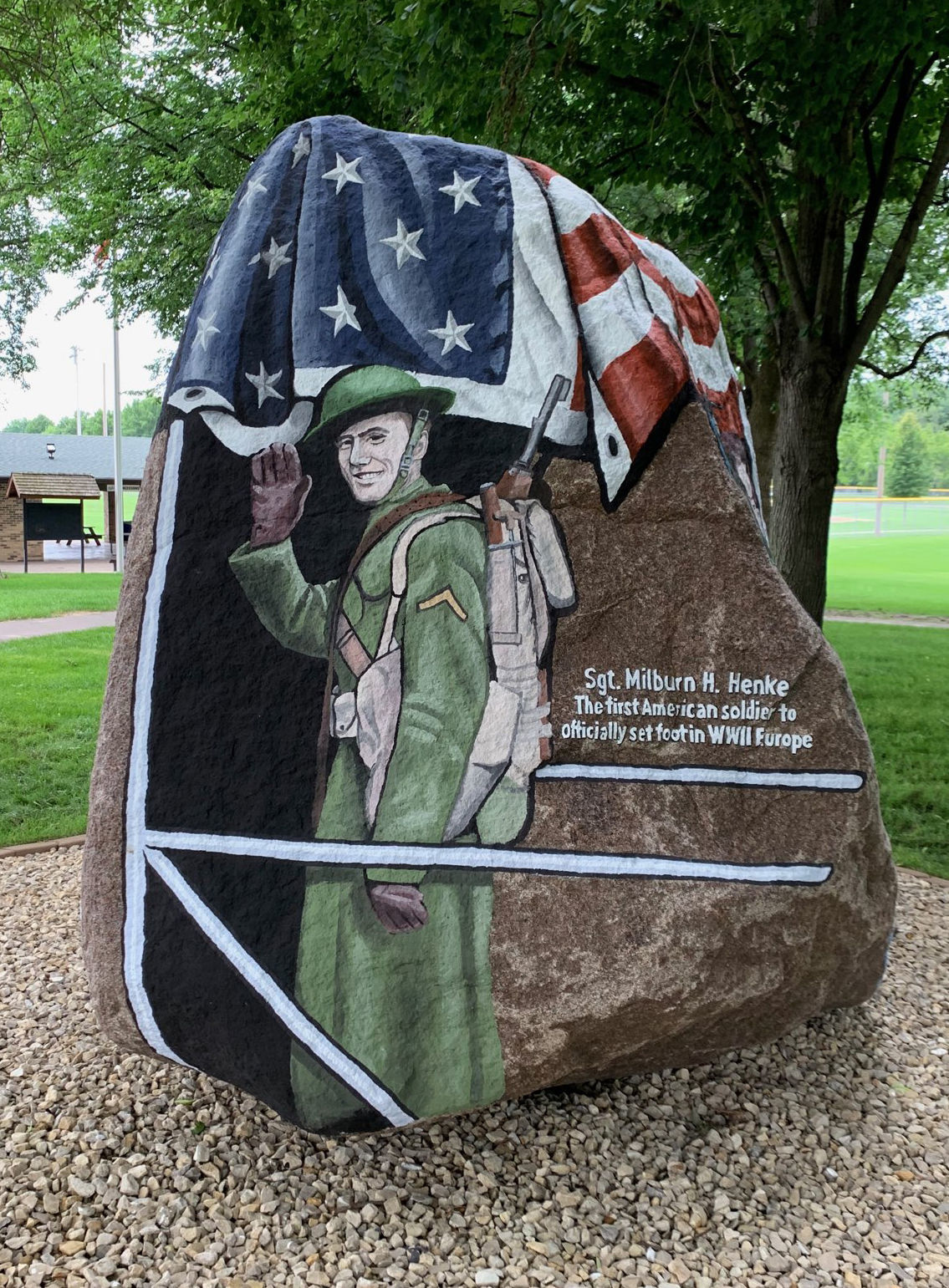

Plenty of Hutchinson residents may know the name Milburn Henke. He was the owner of Henke’s Cafe, which once stood at the corner of State Highway 7 and Main Street, and later next to where you will now find Dairy Queen. He was also a common face in just about every veterans organization in Hutchinson.
But he might be best remembered here and overseas for one particular place in history: He represented his fellow soldiers in World War II as the first official enlisted American to land in the European theater. It’s for that distinction that he was included on a giant rock memorial painted just in time for the Lakeville VFW’s 100th anniversary. The Freedom Rock is one of many painted by artist Ray “Bubba” Sorenson of Iowa, who has painted similar rocks across his home state.
The honor came as a surprise to Henke’s family when it was shown to the public on July 6. Hutchinson resident Evie Bahr caught the unveiling on television.
“I said, ‘I know him. That’s my cousin,’” she said. “It was a real surprise. A beautiful surprise.”
She called Patty Brinkman, Henke’s daughter.
“I said, ‘Patty, did you know about this?’” Bahr said.
She hadn’t, but she was moved by the recognition for her father.
“I would have loved to have been there,” Brinkman said. “I took pride in his patriotism. I was brought up to fly the flag.”
Henke is depicted along with three other Minnesotans on the Freedom Rock: Robert Pruden, who was awarded the Medal of Honor as a U.S. Army soldier in the Vietnam War; Walter Willis, who was flying drills at Pearl Harbor when the Japanese attacked is included; and John Gerdesmeier, a Lakeville local who was killed at age 19 while serving with the Marine Corps in Vietnam.
Sorenson uses paint designed to be used on rocks and material similar to rocks. It won’t last forever, but his studio touts a lifespan that can, in some cases, stretch more than 100 years.
A PIECE OF HISTORY
On one facing of the Freedom Rock, Henke is depicted waving, posed much as he was in a famous picture taken in 1942. At the time, his story was the subject of public interest.
Henke, the son of Carl and Louise Henke, was born on a McLeod County farm in 1918. Three years later his family moved to Hutchinson.
In 1940 he decided to “beat the draft” and enlisted. Henke was assigned to B Company, 135th Infantry Regiment of the 34th Red Bull Division. The enlistees departed for Europe one month after Pearl Harbor, having merged with the Iowa National Guard’s B Company, 133rd Regiment during training.
While Henke and others waited to disembark at Belfast, Northern Ireland, on Jan. 26, 1942, a colonel asked for a man from B Company. Lt. Springer picked Henke.
“They said, ‘Henke, get over there,’” Brinkman said. “He thought he was going to have some kind of detail or something.”
Instead he was approached by Gen. Russell Hartle, who asked if he could talk on the radio — to reporters.
“He said, ‘Well, if I have to, I think I can,’” Brinkman said.
With the National Anthem playing, Henke descended the gangplank as the first official enlisted American man in Europe, though there were soldiers already landed elsewhere. While a crowd roared, Henke was asked to repeat the first step six times so photographers could get the perfect shot. Hartle was surprised when he learned Henke was from Minnesota, as he had planned to have one of his men from Iowa as the first.
“All these important dignitaries were there,” Brinkman said. “A band was playing.”
Henke was thrust into celebrity status. He met Queen Elizabeth and Eleanor Roosevelt. When he called home to his parents and to his sweetheart, Iola Christensen — whom he later married — it was broadcast in Britain and the United States. His face was printed large in newspapers and magazines.
“With all the attention I got, it looked as though the Army’s plan was for me to win the war single-handed,” he recalled, according to the Minnesota Military Museum,
Brinkman said the family received letters from all over, and letters to Henke told him to make sure to get back home to his sweetheart.
Brinkman recalls her father never spoke much about the war. But one particular feat earned him the Silver Star.
While fighting to liberate Tunisia from Axis control, Lt. Springer was injured. Henke and another soldier crawled out of a foxhole and tried to bring him back, but were forced to retreat under heavy fire. Then they tried again, crawling to avoid gunshots. Henke tied a piece of Springer’s coat around his leg and pulled him to safety.
“All the men tried to save him, but he died from his injuries,” Brinkman said. “My dad was awarded a Silver Star.”
Springer’s wife sent Henke a letter, “thanking him that her husband didn’t die out on the field by himself, and thanking him because he died in his fellow soldiers’ arms,” Brinkman said. “He had children, and it meant so much to them that he didn’t die alone.”
She still has the letter, and recalls when she first read it.
“I cried because it made me realize, the Silver Star, how much it did mean. He risked his life,” Brinkman said. “But he didn’t talk about it much. They didn’t talk about those things then, but that’s what I was most proud of.”
BACK HOME IN HUTCH
During preparation to invade Italy, a jeep overturned and fractured Henke’s back. He spent four months in the hospital, returned to duty briefly and was sent home. He asked Iola to marry him, and they were wed Aug. 20, 1944. They had three children: Gary, Bob and Patty.
Henke worked at his father’s cafe before opening Henke’s Cafe with Iola. He became an active member of the American Legion, Veteran of Foreign Wars and Disabled American Veterans. He was asked to participate in numerous parades over the years and helped with Special Olympics. Brinkman said her mother took pride in patriotism, and was always there to help Henke as he sought to honor other soldiers. She sold poppies to gather donations to assist disabled and hospitalized veterans.
During the 10th anniversary of the landing, Henke was photographed holding Brinkman. She still has the photo.
“He always said he just represented all the veterans,” she recalled, “all the soldiers. It wasn’t just about him. And that was so important to him. He was a humble man about this. He was proud of what he had done, but he was humble and gave more than 100 percent of the credit to all of the soldiers. They were all heroes.”
He remained famous in Northern Ireland, however, and was invited back for the 25th and 50th anniversaries of the landing.
As a father, he provided an example of work ethic.
“He always vowed his kids would go to college,” Brinkman recalls. “He would make it happen because he never had the chance. He once said he would hawk his shoes if he would have to, to make sure. We all went to college.”
Operating a cafe turned out to be great work for Henke, who loved to be social.
“Oh my gosh he was a talker,” Brinkman said. “And he worked so hard to provide, he and my mom did. They worked side by side.”
When Henke died April 26, 1998, he was buried at Peace Lutheran Cemetery near several men who followed him down the gangplank all those years ago.
“My mom sold poppies until she was 87 years old,” Brinkman said. “Two years before she died, she had to stop. She laid her last wreath (for Henke) at the ceremony the year before she died.”
In addition to many photos of her father, newspaper clippings and magazine covers featuring Henke are kept by Brinkman, along with other keepsakes. She has his medals, his Silver Star, hats and pins from organizations he was active in, and his dog tags are kept in a case.
The Freedom Rock provided one more way to honor her father.
“It kind of touched my heart,” Brinkman said. “It was another way to remember my dad.”

