

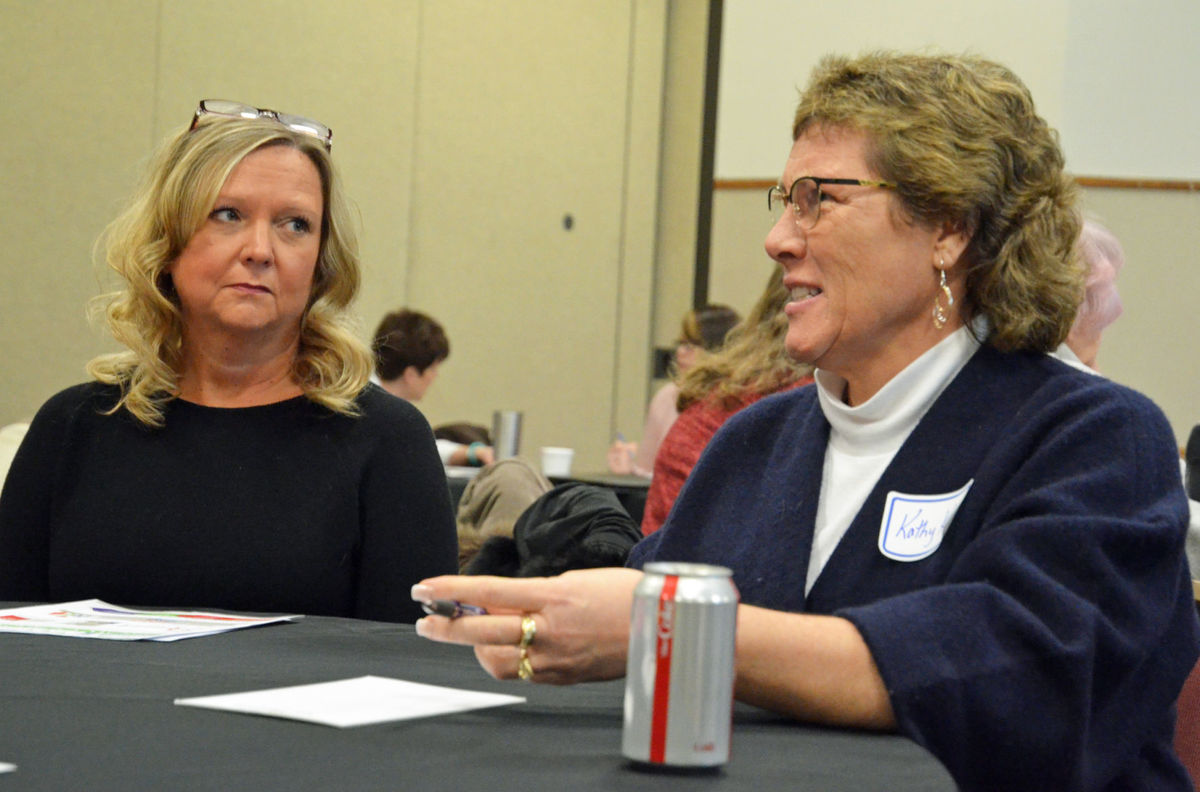

A 10-year effort to narrow the region’s opportunity gap for children was launched locally Wednesday when 40 people participated in a “community conversation” at the Hutchinson Event Center.
Organized by the Southwest Initiative Foundation, the discussion was a followup to a one-day summit 14 months ago in Marshall. The summit’s keynote speaker, Dr. Robert Putman of Harvard University, wrote the bestselling book, “Our Kids: The American Dream in Crisis.”
SWIF used that event to launch its Grow Our Own initiative, which aims to help all kids have a chance to reach their full potential. The effort’s first three years are devoted to raising awareness.
What is the problem?
In a taped interview with SWIF President and CEO Diana Anderson, Putnam said the heart of the American Dream is that hard work and competence is the key to success in life. He contended this principle is less true today, and significantly less true than only 40 to 50 years ago.
Growing class segregation makes it more challenging for children from families living in poverty to succeed, Putnam said. The trend has damaging consequences for families, schools, businesses and other organizations, and all of American society, he said.
In the interview, taped during his 2016 visit to southwestern Minnesota, Putnam talked about his own upbringing in a small Ohio town. There, he said, people from “both sides of the tracks” worked together to get things done. It’s not that way anymore, he said.
Many kids living in poverty have “damaged lives ... through no fault of their own,” he said.
Fortunately, he said, there’s growing public awareness that something needs to be done. “It’s a big deal across party lines,” he said. “It’s a purple problem.”
How’s the problem in Minnesota?
Putnam said Minnesota is unique in that it has a history of citizen cooperation. “I have the data to show Minnesotans are more likely to cooperate to solve social problems,” he said.
But even here, he noted, “There’s trouble in Lake Wobegon.”
A major problem is that Minnesota has among the worst racial economic disparities in the nation.
His advice: Don’t leave it to schools to solve the problem. Families, social service agencies, churches, and businesses must work together to alleviate poverty and give more kids an opportunity to succeed.
“I’m pessimistic of where we’re headed but I’m optimistic we can turn the corner on this,” Putnam said.
The cost of ignoring the problem, he said, is a $5 trillion drain on the nation’s economy over these kids’ lifetimes.
How’s the problem in southwestern Minnesota?
It’s growing worse. One in six kids in the 18-county region, or 11,000 children, lived in poverty in 2017, according to figures supplied by SWIF. That’s an increase of 1,000 from just two years earlier.
Like the rest of the U.S., the income gap in southwest Minnesota between high- and low-income families has grown during the past 15 years.
In the Hutchinson school district, 813 students qualified for the free and reduced lunch program in 2016-17. That means more than 27 percent meet the program criteria of 185 percent of the poverty level.
An estimated 60 percent of students at New Century Academy qualify for the free and reduced lunch program, said Jason Becker, the school’s director.
An estimated 20 percent of kids in Hutchinson younger than 5 live in poverty.
What does Hutchinson have in its favor?
Many social programs. Session attendees — mostly health and human service professionals, educators, clergy members and retirees — met in small groups to talk about “community assets” that help ensure all kids have an opportunity to thrive. More than 40 assets were identified, ranging from the McLeod Emergency Food Shelf and church youth groups to Hutchinson Public Schools’ TigerPath Academies and the summer lunch program.
While those programs do a lot of good, McLeod County Board Member Paul Wright noted they offer overlapping services. Many of those programs request funds from the County Board, he said, explaining the county is looking for ways to streamline services. Wright said the focus on children is important because he’d rather invest taxpayer money on the front end of a problem than spend it on services provided by the jail or sheriff’s office.
What’s next?
Another community conversation is scheduled for 7 to 9 p.m. Thursday, Feb. 15, at the Hutchinson Event Center, 1005 State Highway 15 S. To register in advance, call Tari Niemeyer at SWIF at 320-587-4848.
Organizers said they hope more people in the private sector will attend Thursday’s meeting.
A third session, from 7 to 9 p.m. Thursday, March 8, will center on filling gaps and coming up with other solutions. Those interested are encouraged to call Niemeyer to register.


