



Emerald ash borer has arrived in McLeod County.
Minnesota Department of Agriculture confirmed in an Aug. 18 news release the presence of the invasive species and enacted an emergency quarantine of the county, which restricts the movement of firewood and ash-related materials out of the region.
Infected trees were found on private property a mile east of Crow River Winery by an MDA employee. The discovery makes McLeod County the 42nd in the state to be affected by emerald ash borer.
“It (EAB) will hit in a year or two … since it’s only a couple of miles out of town,” Donovan Schuette, Hutchinson’s arborist said.
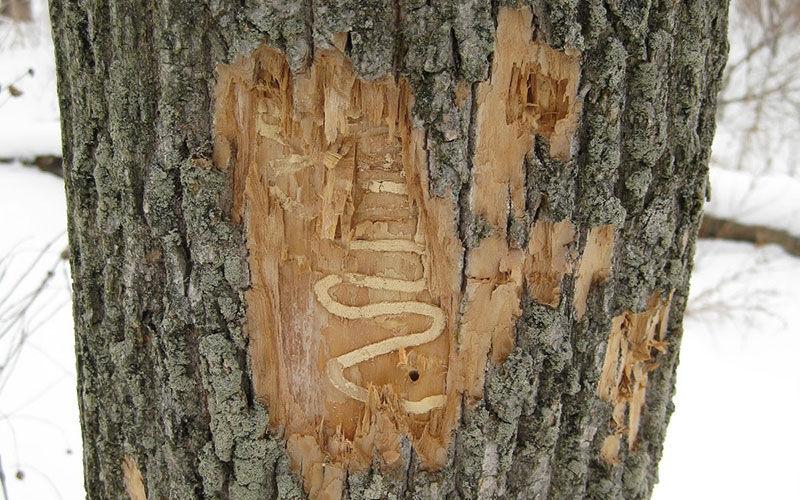
Emerald ash borer was discovered in Minnesota in 2009. The beetle’s larvae harm ash trees by burrowing beneath the bark and consuming the vital nutrient-conducting tissues within the trunk, often causing the bark to split open, revealing characteristic S-shaped galleries.
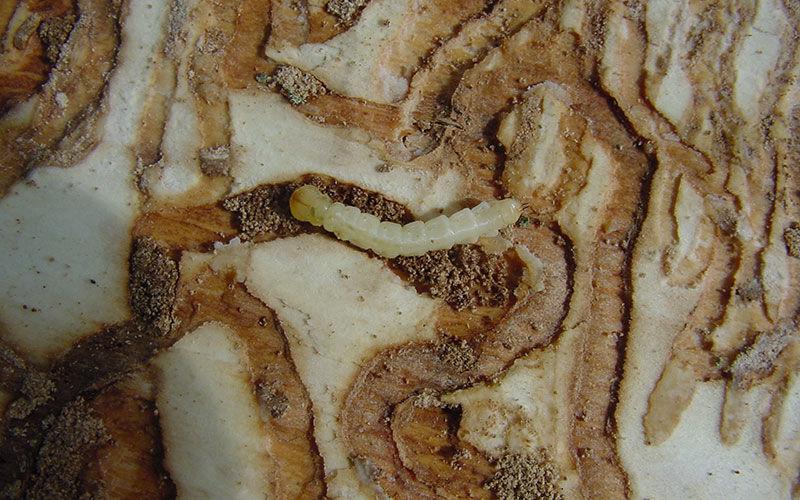
“It looks like a small, clear or white worm,” Schuette said. “It just eats underneath the bark and eats all the tissue that the tree needs to move nutrients and water around. It slowly starves the tree.”
The adult beetle can fly roughly half a mile, from tree to tree, laying eggs and continuing the infestation. However, the primary mode of transportation for emerald ash borer is through human activities, such as moving firewood from one location to another, Schuette said.
Currently, McLeod County has detected emerald ash borer in one location, but neighboring counties such as Wright, Sibley, Carver, Stearns and Kandiyohi are already dealing with more widespread infestations.
Hutchinson started a project in 2015 to reduce the publicly owned ash tree population to less than 15%.
“This project has been ongoing,” Public works Manager John Olson said. “As of today, we estimate the ash tree population has been reduced to around 11% of publicly owned trees, which has exceeded our initial expectations.”
According to Schuette, approximately 675 publicly owned ash trees remain. The city plans to remove an additional 150 ash trees this year.
“We’ve been focused on boulevard trees during the past seven years,” he said, “with ash (trees) in parks near facilities being our second priority.”
In 2010 city officials began preparing for emerald ash borer by setting aside $55,000 per year from the refuse operation. As of 2022, the city has $520,000 set aside for tree disease and infestations, Olson said.
“We anticipate being in a position to remove all publicly owned ash trees and replace approximately 90% of them over a 15-year period,” he said.
If emerald ash borer hit the city now and killed every publicly owned ash tree there would be enough money to remove every boulevard ash tree and replace two-thirds of them, according to Schuette. “The city is in a good position.”
The city anticipates a 10% mortality of ash trees within the next five years, 20% mortality in six to 10 years with the remaining 70% of ash trees being lost in 11 to 15 years, according to Olson.
Hutchinson Public Works Department estimates there are 3,000 to 4,000 ash trees on private property.
“From an aesthetic and environmental perspective, it’s going to hurt,” Schuette said. “There’s going to be some bare boulevards, and it’s not going to look good. But we’re able to get the trees replaced and get new ones going at least. The burden is definitely going to be on homeowners, when this rolls through town.”
Schuette recommends homeowners with ash trees start planning.
“Look for trees that are going to affect your private infrastructure. If it (ash tree) is over your house, at some point you’re going to have to make a decision on that,” he said. “But in woodlots and bottom lands you just let it run its course. It’s almost a 100% kill rate. Over the next 10 to 20 years, it’ll wipe out an entire bottom land, then other native species will start growing.”
Signs to look for an emerald ash borer infestation are, the lower two-thirds of the tree will be flushed with dense green growth, while the upper portion would consist of dead branches. Another indicator, Schuette pointed out will occur in the wintertime when woodpeckers swarm the tree, much like bees.
Homeowners who have a tree on their lot and want to save it have a couple of options, according to Schuette.
“The treatments are relatively accessible,” he said.
The least expensive option is a chemical solution you sprinkle on the ground, which is simple but less effective for larger trees, with only a 50% success rate, according to Schuette.
“You’re going to lose ground pretty quick with that,” he said. “There is an injection that’s 100% effective, but you’ve got to do it every year or two and it’s very involved and expensive.”
McLeod County Parks Department is drafting an action plan, according to Jon Jerabek, Parks and Recreation manager.
“It’s kind of a reactive plan for the most part,” Jerabek said. “When there’s infested trees on public right-of-way or county-owned property, we’ll look at removal.”
The county plans on conducting a tree inventory on some of the higher risk or safety concern areas at some of the parks in open areas or near shelters at campgrounds.
“We’ll be looking at the trees that are around the campsites and just making sure there’s not any infected trees that could cause damage to either our property, other people’s property or injure somebody,” Jerabek said.
According to Schuette, as emerald ash borer moves closer to Hutchinson, homeowners should act proactively to safeguard their property by exploring removal and treatment options and begin obtaining price estimates.
“We’re mostly prepared for it (EAB),” Schuette said. “It’s going to hit hard, especially over the course of about 10 years, there’ll be a lot of changes. What’s going to hurt the most is homeowners. Everyone’s doing fine, then all of a sudden you get a $3,000 bill and that, for a lot of people, that hurts.”


