
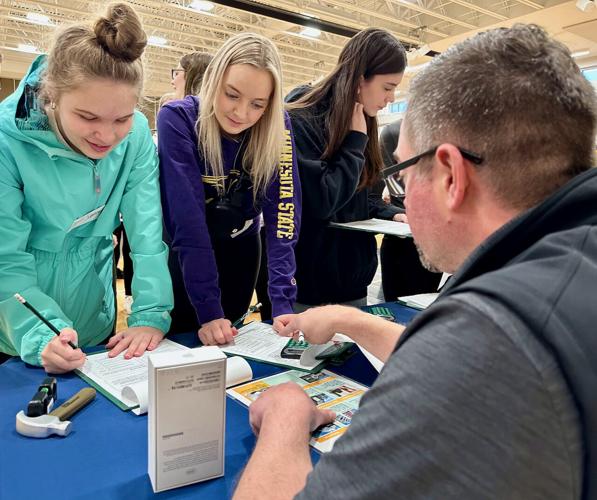


Nick Heining sat at a table, punching numbers into his smartphone’s calculator app and writing them into a budget worksheet he had placed on a clipboard in front of him. Receipts from a clothing store and fast food joint lay beside his budget.
“It’s a lot of what you have to pay for and what you want and what you don’t want, or what you don’t really need, ” the Hutchinson High School sophomore said.
Adults face difficult financial decisions on a regular, sometimes daily, basis. That’s not the case for most teenagers, at least not the kind of decisions that involve paying the rent and buying groceries, going to the doctor and paying the utility bill, and trying to have a little of the paycheck left over to go out to eat and see a movie. Or take that Caribbean cruise they’ve been dreaming of. Or even invest.
But those were the decisions facing more than 80 students in a personal finance class at Hutchinson High School as they participated in Mad City Money, an interactive budgeting simulation. During an almost three-hour session in the school gym, students in Jeffrey Peterson’s personal finance class tried to maneuver the real-life challenges of building a solid financial foundation while meeting the needs of a growing family.
“Students, unfortunately, I think, sometimes don’t always get enough of this in school,” said Megan Karg, branch president at SouthPoint Financial Credit Union in Hutchinson. “I think a lot of kids have a checking account, and hopefully a savings account, but learning the importance of saving, and having that emergency fund if things come up, and being able to save for things that you want to do in the future? No. So we hope they get a little of that today.”
The personal finance students were among students at seven area schools who have participated in Mad City Money, an interactive budgeting simulation used by credit unions throughout the country, and made available locally through SouthPoint’s sponsorship.
The credit union has offered the program on a variety of different levels, Karg explained, from Glencoe-Silver Lake High School where the entire student body participated, to the junior class at Howard Lake-Waverly-Winsted High School, to the sophomore and senior classes at New Century Academy in Hutchinson.
“Our hope is that in Hutchinson High School we’ll be able to find a way to get it to the entire student body so that not just kids taking personal finance receive it, but everyone will,” Karg said.
But Karg admitted that she and her team at SouthPoint are just happy to be making Mad City Money available to students in grade 10-12 at any of the area schools. It’s a program the credit union wanted to launch a few years ago, but the COVID-19 pandemic made it unrealistic until this year, when it was rolled out in the first area school in January.
“At the credit union, we do a lot with financial education,” Karg said. “It’s a big part of what our business development team works on. And we do a lot of stuff in the schools. We do a lot with Junior Achievement. This is a way for us to provide (financial education) free of charge, in hopes that they learn that being an adult is not that easy, you know, and having a budget is a very important tool to be successful in your future.”
Participating students get a taste of real world decisions when they arrive for the simulation and are assigned an occupation and salary, along with an imaginary spouse and one child, then visit eight different stations, or merchants, where they purchase housing, transportation, clothing, food, home items, daycare and “fun stuff,” Karg explained. The goal is to have money left at the end of the simulation, but not more than $100.
And while that might not seem that difficult — just math, right? — like life, Mad City Money throws its residents a curveball every now and then. As students visited the various stations in the HHS gym, Karg or another of the adult volunteers might walk up and begin a conversation with them, then hand them a green or red dot with an explanation that they had been hit with an unexpected expense, or for the fortunate ones, a surprise windfall.
“That person is the fickle finger of fate,” Karg said, “and they’re handing out additional expenses or windfalls that the students might receive, because that’s real life, right? You could be driving to work and you get a flat tire and you’ve got to fix it, because you’ve got to be able to get to work. So, definitely, an unplanned expense, if you don’t have money set aside, that can really make things difficult for you.”
The simulation seemed to be an eye-opener for many students as they talked with the bankers and insurance agents, along with SouthPoint employees and other volunteers from the school and community, including Hutchinson Chamber of Commerce President Mary Hodson and Rebecca Boll, director of business and finance for the school district.
“It’s all what you have to pay for and what you want and what you don’t want, and don’t need,” Alexis Sanken, a junior, said after she and classmate Sydney Harpel finished talking with a banker about financing on a new home.
“It’s kind of, what best fits you,” interjected Harpel, a senior, who said her parents urged her to take the personal finance class at school. “You have to see what you can afford.”
Some students were likely to run into trouble during Mad City Money, Karg said, but they could learn from those mistakes, without the stress of financial burdens, in a safe educational environment.
“So if they go overdrawn at some point in time, we direct them to go to the credit union to get some financial counseling,” Karg said. “A lot of times, what happens is they’ve either made some sort of adding or subtracting error in their balance sheet, or they have to make a return, they probably got too big of a house or too expensive of a car. So they have to get counseling on that and then go back, return the vehicle or house and buy something more within their budget.
“It’s a small glimpse into their future, for sure,” Karg said. “Hopefully, they got back and talk to their parents about it, and have that conversation and learn even more.”


