
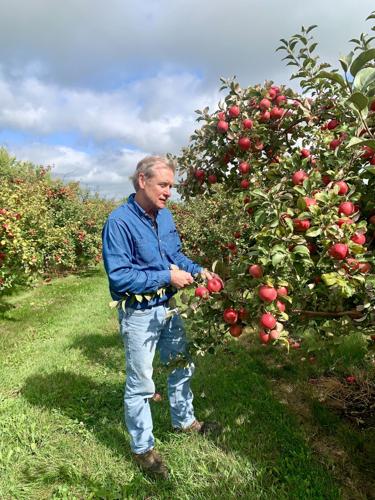


Joe Carlson discovered his love for agriculture during his sophomore year of high school in 1970 when his family bought a 200-acre farm in Winsted. He found himself immersed in the world of farming, spending three years working alongside his father on their farm.
“I got the agricultural bite,” Carlson said. “I loved agriculture and I wanted to figure out a way to make agriculture work in a way that I liked.”
Agriculture hooked him, and he embraced it wholeheartedly, but Carlson wasn’t certain how he could translate that love into a fulfilling career. His work in non-destructive testing took him to the Pacific Northwest. Traveling through the region, he couldn’t help but notice the flourishing agricultural landscapes that were filled with orchards and vineyards, he said.
“Traveling around I saw apples and I thought,’ I love agriculture, how can I make this work,’” Carlson said.
His fascination with these thriving agricultural regions, particularly the apple orchards he encountered, stirred the question: Could apples be grown successfully in Minnesota? This curiosity led him to reach out to the University of Minnesota, seeking answers and guidance. The university advised Carlson that Minnesota could indeed produce excellent apples.
Minnesota’s apple legacy dates back to the mid-1800s when European settlers encountered difficulties growing their favorite fruit trees due to harsh winters. In response, the University of Minnesota established a fruit breeding program over a century ago.
“In order to grow fruit trees, we needed to invent new varieties,” said Jack Tillman, University of Minnesota fruit breeding researcher. “Some of our varieties do better here than they do anywhere else.”
The university’s program played a critical role in producing apple varieties uniquely tailored to the state’s environment. Over the years, it has introduced several popular apples like Honeycrisp and Sweet Tango, notable for their crisp textures and exceptional flavors, he said.
After talking with the university, Carlson decided to turn the family farm in Winsted into an apple orchard, which has become a popular destination for apple enthusiasts.
This year is one of the best apple seasons Carlson has seen on his orchard, “I’ve got over 2,000 bushels,” he said.
Carlson and his late wife, Colleen, started the orchard, building it from the ground up, planting the first trees in 1985. In 1994 they added to the business, converting the 1931 pig barn into a restaurant and bakery.
However, what might be his best crop could be Carlson’s last. After 31 years he’s ready to hang his boots, enjoy the fruits of his labor and return to Oregon.
“I want to retire,” he said. “But you get a business going like this, if it can continue why not keep it going? I just have to move off … just losing Colleen, it makes me realize life is short. I’ve got two boys, one in the accounting-slash-financial world in North Dakota and one’s a nurse down at Mayo (in Rochester) and they’re happy doing that. I don’t have family members to, I don’t have enough kids. I don’t have somebody I can say, ‘here’s the perfect one to do this.’”
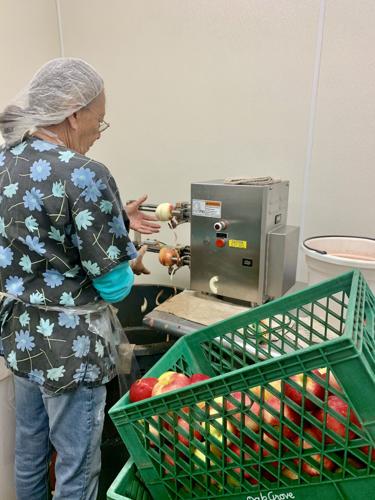
Carlson’s Orchard Bakery and Restaurant has been a staple in the county since 1992, serving homemade soup and sandwiches on freshly baked bread with fresh pies in addition to the apples, but this year the restaurant will be closed for the season.
Colleen Carlson died in 2021, leaving big shoes to fill at the restaurant.
“We lost Colleen, and she was just a godsend to everybody that met her,” Carlson said. “Losing Colleen was a big jolt in the business and it’s hard to find that manager to replace her.”
Carlson and his wife planted the farm with apple trees in 1985, then returned to Oregon so Joe could work. The two spent years traveling back and forth working on the orchard. Carlson worked full-time in Oregon, while Colleen came back and ran the show in the summertime. She even installed the orchard irrigation system.
“By the seventh year we needed to make the decision of coming back full-time to do apples or stay in Oregon,” Carlson said. “I fell in love with Oregon, and I didn’t want to come back, but we had this investment made, so we made the decision, let’s bring our two boys back here. They came back at age 4 and 3, just a perfect time to start growing up on a farm.”
Oregon was nice but Carlson got hooked on apples, he said. His job in non-destructive testing helped finance the operation, so they were able to pay as they went without going into debt.
The orchard now hosts 3,500 apple trees and 10-12 varieties. This year the orchard bakery staff is on track to make 20,000 to 25,000 pies which will be sold at stores and through fundraisers.
Carlson’s Orchard has a special relationship with the University of Minnesota. The apples on his orchard were all developed by the university.
“This site grows good Honeycrisps,” Carlson said. “The university has this tremendous need for fruit because they sell fruit at their apple house, and they don’t grow enough fruit. I need partners like that to get this crop harvested. Once it’s ready to go, you have to get it off the tree when it’s at its peak. So the university would be somebody that will come out. They typically come out every year and make two or three runs, 100 bushels a run. We have a great relationship with them. We also sell them their pies.”
Cecil Horseman has worked at Carlson’s Orchard for 12 years and said this year’s crop is the best he’s ever seen.
“This is a big crop,” he said. “I remember when Joe had 700 bushels and I thought that was a lot but 2,000!”
Carlson has received numerous calls from the community urging him to keep the business running. He is looking for alternatives to do so while still taking a step back, he said.
Running a business that blends the worlds of hospitality and apple farming requires a unique set of skills and a passion for both industries, he said.
“Growing apples is, you get them under control, work them, hire some people to do some of the jobs, manage it. And it gives you a lot of freedoms,” Carlson said. “It helps to be mechanical, work with tractors, work with equipment, work with people. You have to be a people person. You’re going to have to hire when the restaurant is going, we hire between 45 and 50 people to run that.”
In order to help with the larger-than-ever crop Carlson is offering you-pick hours from 10 a.m. to 4 p.m. Wednesdays through Saturdays until Oct. 28.
“We’ve had some wonderful people, our employees have been wonderful,” Carlson said. “It’s been a great business. I have no regrets doing it. Colleen and I have asked, would we do it again? And we both had to think about it a little bit, because there’s some good and bad times to it. But the good times, the good outweighs the bad.”


